Hermes Agent: The Open-Source AI Teammate People Want (And OpenClaw Isn’t)
Imagine this: it’s 11:47pm, your laptop’s closed, and “your AI” is still working—researching tomorrow’s post, drafting a client update, and pinging you on Telegram only when it needs a yes/no decision. Not a chatbot. Not a fragile automation chain. More like a night-shift teammate.
That’s basically the pitch behind Hermes Agent—and it’s why a bunch of folks are side-eyeing tools like OpenClaw lately.
Here’s the thing: most automations don’t get better

If you’ve used typical agent/automation tools, you know the vibe: you set up a workflow, it runs… and when it breaks, you fix it. Next week it breaks again, and you fix it again. It’s like owning a Roomba that keeps eating the same sock.
Hermes Agent (from Nous Research) is positioned differently: a self-hosted, open-source autonomous agent with persistent memory and a self-improving learning loop that can write its own reusable skills after it succeeds at something. Sources describe it as launching in February 2026, MIT-licensed, and designed to run locally or on your own server/VPS. [2][4][6]
So instead of you rebuilding the same “research → outline → draft → repurpose” pipeline every time… Hermes tries to turn that pipeline into a skill it can reuse. That’s the big idea. [2][3][6]
Hermes vs OpenClaw (the way users talk about it)
Look, I’ll be honest: the simplest explanation is this…
- OpenClaw is a tool you configure. You tell it what to do, wire it up, and babysit the edges.
- Hermes is marketed like a teammate that learns. It remembers context, improves from outcomes, and tries to capture wins as reusable skills.
Hermes also leans hard into “live where you work” messaging: it can connect through Telegram, Discord, Slack, WhatsApp, Signal, Email, and CLI. [2][4] That’s huge for entrepreneurs and creators because… who wants to live inside yet another dashboard?
On the OpenClaw side, there’s also the security chatter. In the framing you provided, OpenClaw had three critical CVEs in 2026, including one scored 8.8 CVSS. I can’t verify those CVE details from the provided primary sources here, so treat that as a claim to confirm before you repeat it publicly—but yes, security reputation alone can cause a migration wave. [6]
The Bottom Line (TL;DR)
The bottom line is… Hermes is built around persistence + learning + skill reuse. OpenClaw (as users frame it) is more like a configured automation tool. If you want something that improves the longer it runs, Hermes is the more compelling story. [2][3][4]
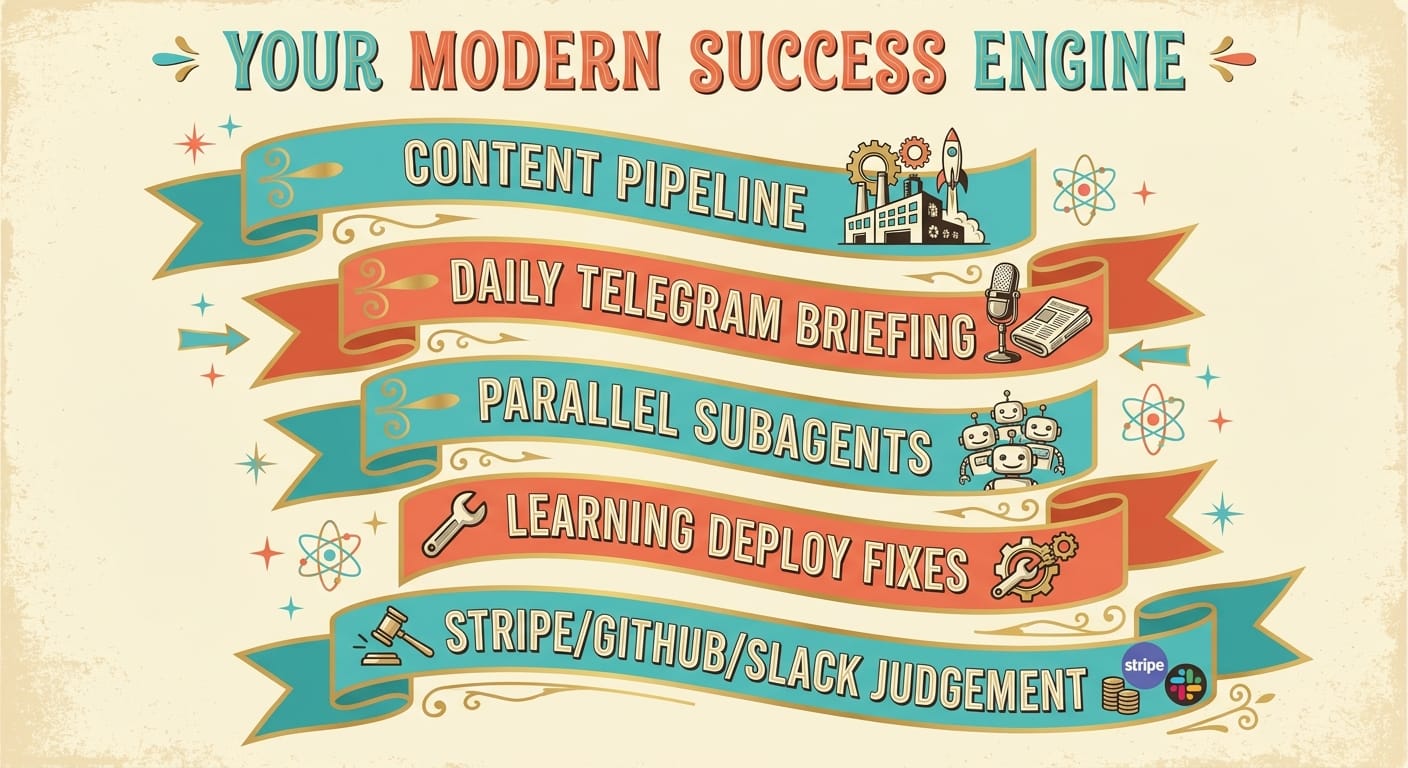
5 practical ways founders and creators actually use Hermes
Here’s what most people miss: “autonomous agent” sounds sci-fi until you attach it to boring, repeatable business tasks. That’s where it gets real.
- Content pipeline (research → publish) Hermes can research a topic, summarize sources, draft an outline, write a first draft, then adapt it for LinkedIn/newsletter/X—and save the successful pattern as a reusable skill. That’s the dream for anyone shipping content weekly. [2][3]
- Automated daily briefings via Telegram Because Hermes supports Telegram gateways, you can have it send a daily “what matters today” briefing (news, competitor moves, content ideas) without you opening a laptop. [2][4]
- Parallel subagent research Need three angles fast—customer pain points, competitor positioning, and pricing pages? Hermes-style agents are often described as being able to spawn subagents to do parallel work streams. [3]
- Deployment pipelines that learn from failures When a deploy fails, the agent can analyze logs, propose fixes, and—if the fix works—capture that as a reusable recovery skill. That’s not magic; it’s just “stop making humans solve the same outage twice.” [3]
- Stripe/GitHub/Slack automation with mid-pipeline judgment This is my favorite category: events come in (Stripe payment failed, GitHub issue opened), Hermes checks context, then chooses the right action (open a ticket, message Slack, email a customer, or ask you a clarifying question). It’s not just triggers—it’s judgment in the middle. [2][4]
Quick wins: run Hermes 24/7 for $5–10/month (without getting fancy)
If you want the “always on” benefit, you don’t need a GPU server the size of a refrigerator.
- Get a cheap VPS ($5–10/month tier can work for lightweight workloads).
- Run Hermes via Docker so updates/rollbacks are painless.
- Use systemd to keep it running and auto-restart on crashes.
- Connect Telegram so it can message you from the server even when your laptop’s closed. [2][4]
Important nuance: that VPS price is plausible for the server. Your real cost depends on whether you’re calling paid model APIs, how much you run, and whether you’re hosting models locally. [2][4]
Common mistakes (aka how people accidentally make agents useless)
- Trying to automate chaos. If your process changes every day, the agent can’t “learn” a stable skill. Start with repetitive workflows.
- No guardrails. Give it permissions like you’d give an intern. It shouldn’t have production keys on day one.
- Confusing “memory” with “truth.” Persistent memory helps continuity, but you still need validation steps for critical outputs.
FAQ
Is Hermes Agent actually open-source?
Yes—Hermes is described as open-source and MIT licensed, with official pages emphasizing self-hosting and no cloud lock-in. [2][4]
What makes it “autonomous” compared to a chatbot?
Autonomy here means it can plan and execute multi-step tasks, use tools, keep state across sessions, and (per descriptions) capture successful workflows as reusable skills. [2][3]
Do I need to run it on my own server?
No, but that’s the appeal: you can run it locally or on a VPS and keep it running 24/7 with messaging gateways. [2][4]
Is the “150k GitHub stars in 3 months” claim real?
That number is reported in secondary chatter, but the clean way to verify momentum is the repo itself—stars, issues, commits, release cadence. Check GitHub directly. [6]
What’s next (if you’re tempted to switch)
If you’re coming from OpenClaw (or any configured automation tool), don’t migrate everything at once. Pick one workflow you repeat weekly—like “Monday content brief” or “daily KPI roundup”—and let Hermes run it long enough to see whether the skill-learning loop actually saves you time.
Because if it does? Congrats, you didn’t just adopt a tool—you hired the cheapest night-shift operator you’ll ever find.
Sources
- [2] Hermes Agent official site (overview, MIT license, self-hosting, memory, gateways)
- [3] Third-party review/explainer describing autonomous execution and learning loop
- [4] Hermes Agent documentation pages (install, platform messaging support)
- [6] Hermes Agent GitHub repository (activity and popularity verification)