SpaceXAI Drops Grok 4.5 — The “Opus-Class” Price War Just Got Real
What if “the best model” stopped mattering… and “the cheapest model that finishes the job” became the only KPI anyone cared about?
Because that’s basically the bet SpaceXAI is making with Grok 4.5, launched July 8, 2026—their first big release since absorbing xAI (Feb 2026), going public, and turning the $60B Cursor acquisition into a training partner instead of just a product line. It’s not a “we crushed every benchmark” announcement. It’s a “we’ll crush your AI budget spreadsheet” announcement. And yeah, that’s a different kind of flex. [2][3][5]
Here’s the problem SpaceXAI is solving (for agencies and businesses)
Look, I’ll be honest: most teams aren’t losing because they don’t have the #1 model on some leaderboard. They’re losing because:

- AI usage quietly grows… then finance taps you on the shoulder.
- Your “simple” workflow turns into a token-eating, multi-step monster.
- You’re paying premium rates for tasks that don’t need premium intelligence.
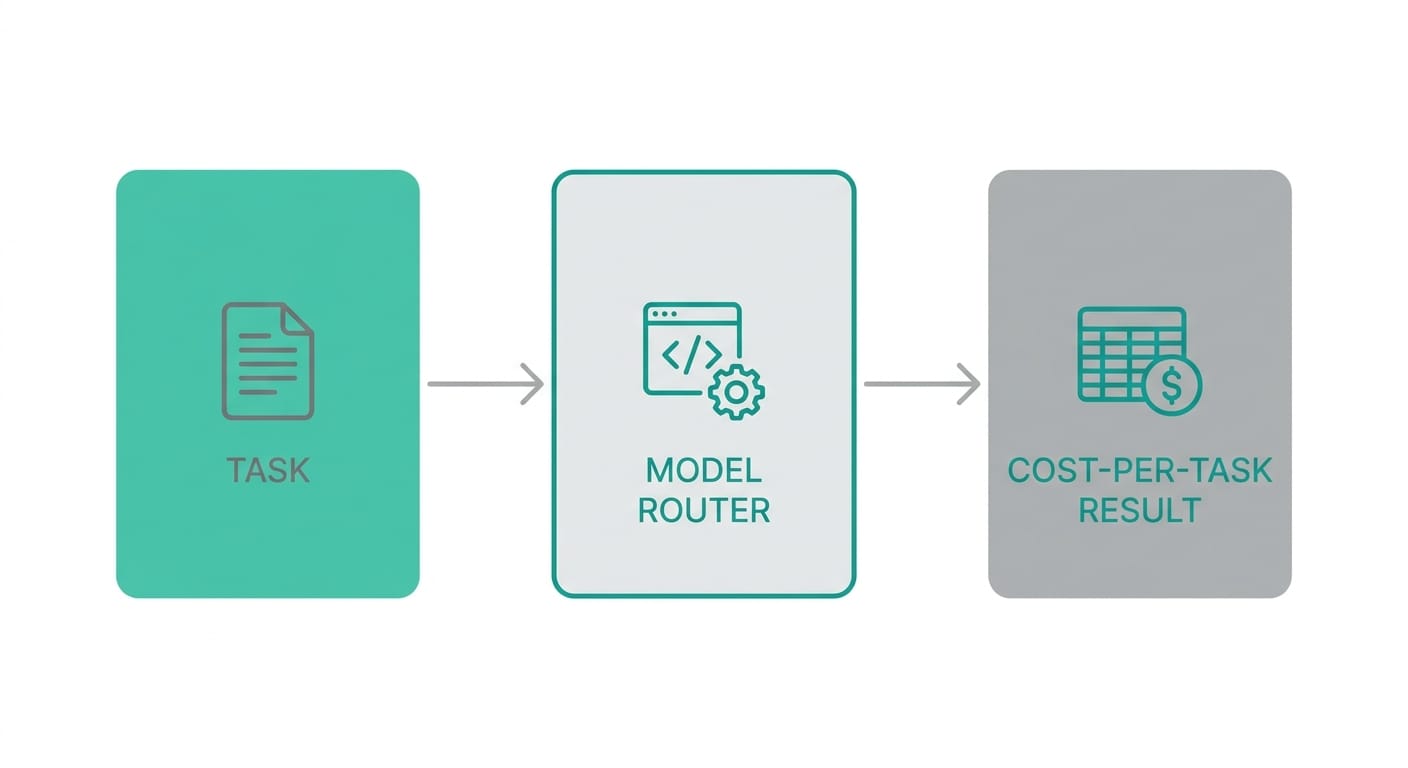
So SpaceXAI’s pitch with Grok 4.5 is basically: “Stop shopping by IQ. Shop by cost-per-task.” [3][5]
The solution: Grok 4.5 is priced to be your default work model
Grok 4.5 is positioned as “Opus-class” capability—aimed at coding, agentic workflows, and business knowledge work—but with aggressively value-focused pricing. [2][3][5]
1) The headline pricing is a direct shot at “premium output tokens”
SpaceXAI set Grok 4.5 at:
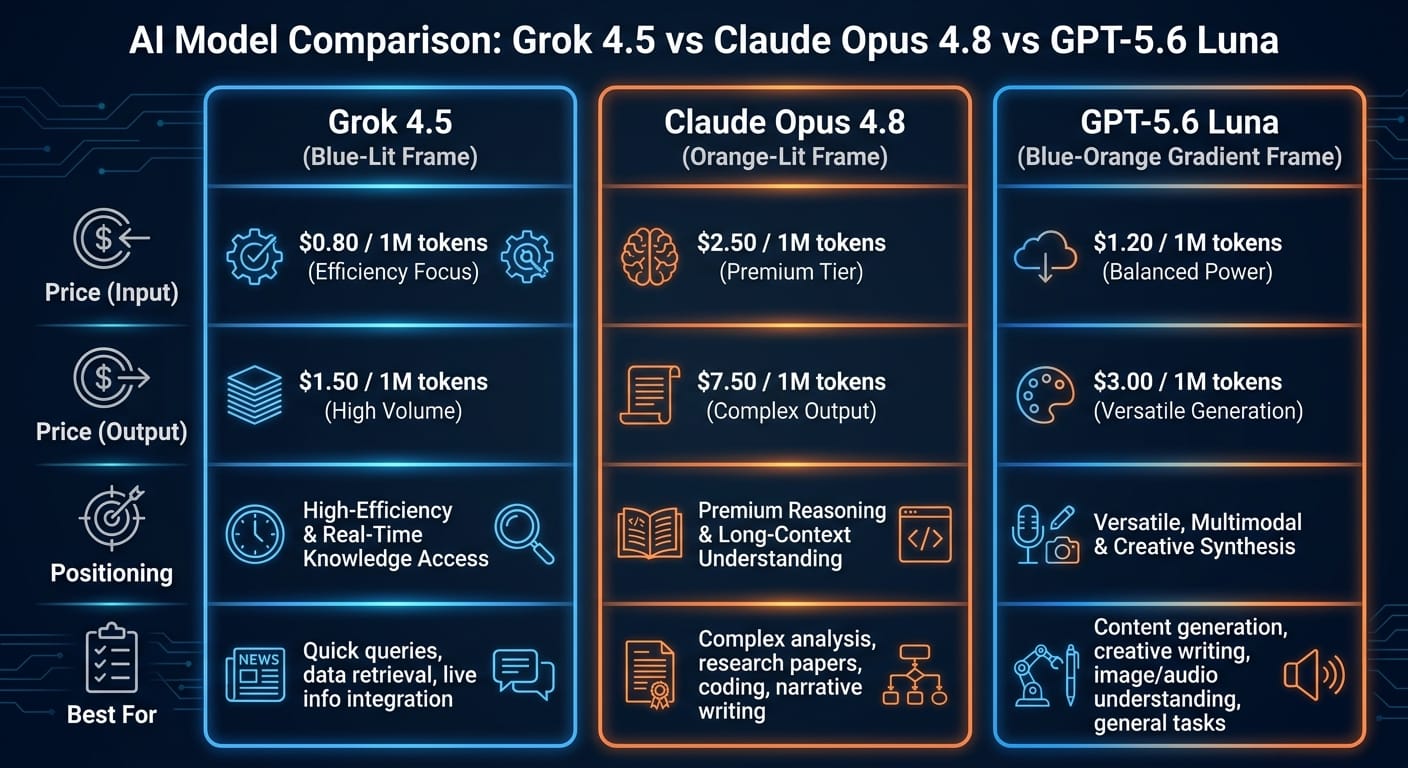
- $2 / million input tokens
- $6 / million output tokens
Compare that with Claude Opus 4.8 at $5 in / $25 out, and GPT-5.6 Luna at $1 in / $6 out. [1][2][4][5]
Here’s what most people miss: output tokens are where a lot of real workloads get murdered—summaries, reports, legal analysis, slide creation, you name it. So $6 vs $25 is not a rounding error; it’s the difference between “ship it” and “pause the automations.”
2) Musk’s real claim is token efficiency (aka fewer steps)
SpaceXAI is leaning hard on efficiency claims—Musk and analysts point to Grok 4.5 being meaningfully more token-efficient, with commentary citing up to 2× token efficiency and fewer steps to finish tasks. In at least one framing, that rolls up to a much lower effective cost-per-task versus rivals. [2][3][5]
Think of it like hiring: you don’t care what someone charges per hour if they finish in half the time, right?
3) It’s not just “a model,” it’s a distribution move (Cursor + Grok Build)
Grok 4.5 is rolling out as the default model in Grok Build and across all Cursor plans—which matters because distribution beats a lot of technical advantages. [1][2][3]
And it’s not subtle that Cursor helped train it. Cursor has publicly said they partnered with SpaceXAI to train Grok 4.5—this is the first big “co-trained with Cursor” moment after the acquisition. [2][3][4]
4) Speed + context: this is built for long, messy work
Reported serving specs put Grok 4.5 around 80 tokens per second with a 500K context window. That’s the kind of combo you feel when you’re dumping in long docs, big codebases, or months of campaign notes. [2][4]
5) The “office agent” angle is real (and honestly, overdue)
Instead of marketing Grok 4.5 as “just a coding model,” SpaceXAI is positioning it for knowledge work: it can build multi-sheet Excel models, produce PowerPoint decks with native shapes, and analyze legal documents. It’s even been touted as #1 on Harvey’s Legal Agent Benchmark. [3][5]
That’s a very different product vibe: more “operator in your business” and less “chatbot that writes poems.”
6) Benchmarks: good enough to ship, not the undefeated champion
On coding benchmarks, Grok 4.5 is described as mid-pack—for example, 3rd on DeepSWE 1.0 and 83.3 on Terminal Bench 2.1—while other models (like Fable 5 and Opus 4.8) still take top spots in various rankings. [3][5]
The bottom line is: SpaceXAI isn’t claiming “best.” They’re claiming “best deal per completed task.”
7) The wild part: they profit from rivals’ compute while racing them
This is the part that feels like a business case study disguised as an AI launch.
Grok 4.5 was trained on large NVIDIA GB300 clusters—the same kind of compute SpaceXAI leases to competitors like Anthropic and Google—reportedly part of deals totaling around $920M/month. So while they’re undercutting model pricing, they can also make money renting the “picks and shovels” to other gold miners. [1][2][5]
If you’re an entrepreneur, you’ve gotta admire the audacity. It’s like running the toll road and also selling the cars.
Comparison table: Grok 4.5 vs the obvious alternatives
Quick Wins: how to decide if Grok 4.5 belongs in your stack this month
- Run a “cost-per-task bakeoff”: pick 10 real tasks (reports, briefs, code refactors) and compare total tokens + outcomes.
- Test long-context workflows: throw in a chunky contract, a 40-page strategy doc, or a repo + docs bundle.
- Try an office deliverable: spreadsheet model + slide deck + summary memo—see if the workflow actually saves you hours.
- If you’re already on Cursor, turn it on and measure—distribution is half the point here. [2][3]
FAQ
Is Grok 4.5 the best model in the world?
No. It’s competitive, but reporting and analyst commentary frame it as not the raw benchmark king across the board. The strategy is value and efficiency. [3][5]
What’s the biggest practical upgrade for non-technical teams?
The “office agent” positioning: structured outputs like spreadsheets, presentations, and legal doc analysis—work artifacts, not just chat. [3][5]
Where can I use it?
Grok 4.5 is available via Grok Build, across Cursor plans, and through SpaceXAI’s API/console. [1][2][3]
What about the EU?
EU availability was expected mid-July (after the initial launch window), according to reporting. Confirm status before you standardize if you serve EU customers. [2][4][5]
Sources
- [1] SpaceXAI product/platform availability notes referenced in coverage (Grok Build default model) and analyst summaries.
- [2] Reuters coverage on Grok 4.5 launch date, pricing, compute/training details, and rollout plans (incl. EU timing).
- [3] Constellation Research analysis on Cursor acquisition relevance, positioning, and value/cost-per-task framing.
- [4] Additional launch coverage (incl. pricing comparisons and availability) cited in public reporting.
- [5] Axios coverage on business positioning, competitive dynamics, and vertical integration/compute leasing intrigue.
What’s next?
If Grok 4.5’s bet works, the next 6–12 months of AI buying will look less like “pick the smartest model” and more like “build a routing layer that sends each job to the cheapest model that won’t embarrass you.”
So the real question is: do you know your cost-per-task today—or are you still shopping by vibes?