AI-Generated Content: The Shortcut That Still Needs a Driver
AI-generated content can be a superpower—if you stop treating it like autopilot. Here’s a practical 5-step workflow to get speed without sacrificing voice, credibility, or SEO.

AI-generated content isn’t the future of writing. It’s the future of drafting—and if you treat it like a “set it and forget it” content machine, you’re gonna publish a lot of beige fluff that doesn’t rank, doesn’t convert, and (worst of all) doesn’t sound like you.
Here’s the thing… the teams winning with AI content aren’t the ones pumping out 200 posts a month. They’re the ones using AI like a power tool: fast, consistent, and occasionally dangerous if you don’t keep your fingers out of the blade.
The Real Problem: AI Can Write Words, Not a Point of View
Most people start with the wrong question: “How do I generate more content?”
The better question is: “How do I generate more useful content without losing my voice or my credibility?”

Because AI is great at:
- Summarizing a topic
- Drafting outlines
- Rewriting in different tones
- Spitting out variations for ads, emails, and social posts
And it’s… not great at:
- Having original lived experience
- Knowing what’s true right now without sources
- Understanding your audience’s inside jokes, objections, and context
- Creating a real brand POV (unless you teach it)
Look, I’ll be honest: if your content strategy is “publish whatever the model says,” your readers will feel it. So will Google. Google’s guidance has been pretty consistent: they reward helpful, people-first content, not content made a certain way. Translation: AI content is fine—bad AI content isn’t.
Solution: A Simple 5-Step Workflow That Actually Works
Here’s what I recommend if you want AI-generated content that doesn’t sound like a brochure written by a toaster.
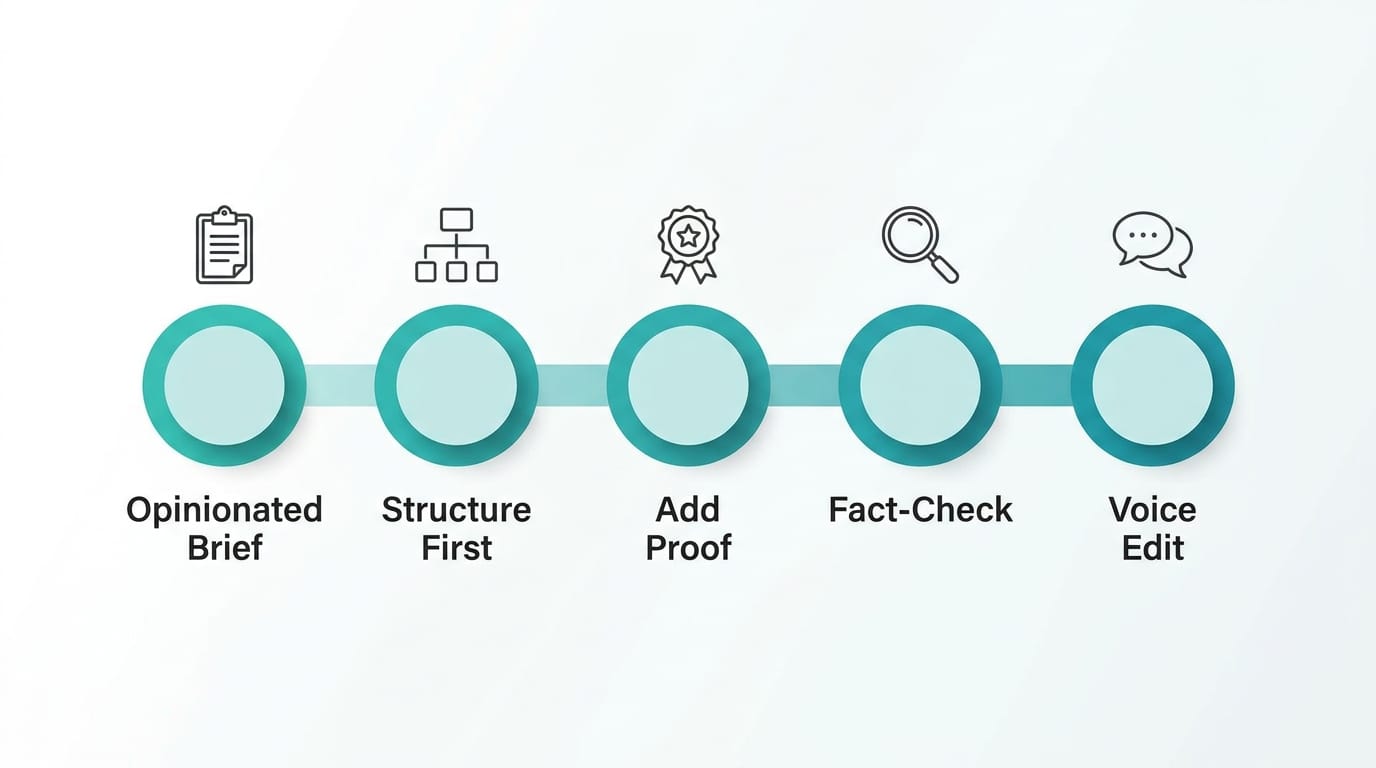
Step 1) Start with an opinionated brief (not a vague prompt)
If you feed AI a bland prompt, you’ll get a bland draft. Your brief should include:
- Who it’s for (specific persona)
- What they already believe
- What you want to convince them of
- Your examples, stories, and “only we know this” details
Step 2) Make AI do structure first, then writing
Don’t ask for a full post right away. Ask for:
- 3 headline options
- an outline
- key objections
- missing angles
Then have it draft section-by-section. You’ll spend less time “fixing” and more time “directing.” Like a film set, not a vending machine.
Step 3) Inject your real-world proof
Here’s what most people miss… credibility comes from receipts. Add things like:
- Metrics you’ve seen (even rough ranges)
- Screenshots, templates, checklists
- Mini case studies (what happened, what you changed, what improved)
- First-person lessons (“what I thought would work… and what actually did”)
Step 4) Fact-check and source anything that smells like a claim
AI will confidently hand you nonsense sometimes. It’s not malicious—it’s just a very convincing autocomplete.
If your post mentions policy, health, finance, legal topics, or “Google said X,” you need sources. Even for marketing claims, a quick verification pass saves embarrassment later.
Step 5) Edit for voice, not grammar
Grammar isn’t the issue. Personality is. Do a final “voice edit” pass:
- Cut corporate filler
- Add your phrasing and rhythm
- Replace generic advice with your specific advice
- Make the intro and conclusion sound like a human with a point of view
Common Mistakes (aka How People Accidentally Publish Content Soup)
- They skip the brief. The model guesses what you mean, and it guesses wrong.
- They don’t add firsthand detail. Without that, your content sounds like every other post on the internet.
- They don’t verify facts. “Confidently wrong” is the worst kind of wrong.
- They chase volume over usefulness. You don’t need 50 posts. You need 5 that actually help.
Pro Tips Box: Make AI Sound Less Like AI
My go-to moves:
- Give it your “banned words.” Tell it to avoid: “delve,” “unlock,” “revolutionize,” “robust.” Your readers will thank you.
- Ask for punchier rewrites. “Rewrite this paragraph like a founder explaining it to a smart friend.”
- Force specificity. Prompt: “Add 3 concrete examples and remove vague statements.”
- Use AI as an editor. “What’s unclear? What assumptions am I making? Where will a reader disagree?”
Case Study Snippet: A Realistic Before/After
Let’s say a SaaS company is publishing SEO posts. They switch to AI and triple output… and traffic goes up a little, but conversions drop.
Why? The content answers keywords, but not buying questions.
They fix it by adding:
- comparison sections (“X vs Y”)
- implementation screenshots
- pricing considerations and pitfalls
- a “who this is for / not for” paragraph
Same AI. Different workflow. Content goes from “technically correct” to “actually useful.”
FAQ
Is AI-generated content bad for SEO?
No. Google’s stance is that they care about content quality, not whether a human or AI produced it—so long as it’s helpful and people-first.
Should I disclose I used AI?
Depends. If it materially affects trust (medical, financial, legal, or investigative content), transparency is smart. For marketing drafts that are heavily edited, disclosure is usually less critical than accuracy and value.
What’s the fastest win with AI content?
Use AI to repurpose your best material: turn one good article into an email, a LinkedIn post, a short script, and an FAQ section.
How do I keep my brand voice consistent?
Create a one-page voice guide (do/don’t, sample paragraphs, favorite phrases, level of humor). Then paste it into your prompt or your model’s custom instructions.
Sources (Worth Skimming)
- Google Search Central: Creating helpful, reliable, people-first content
- Google Search Essentials (quality + spam policies overview)
- OpenAI Usage Policies (content and safety considerations)
What’s Next
The bottom line is… AI-generated content works when you treat it like a drafting partner, not a publishing button.
If you want a practical next step, build a “content brief template” your team uses every time. It’ll do more for quality than swapping models or buying another tool.
And if you’re curious, the next rabbit hole is AI + content operations: versioning, approvals, fact-check workflows, and brand voice libraries. That’s where things get fun.