AI Isn’t “Cheaper Than People” Yet — It’s Just Billed Differently
Only 18% of companies had adopted AI by the end of 2025—and that’s in the same universe where Big Tech is dumping hundreds of billions into AI infrastructure.[2] So if you’ve been feeling like the hype and the reality aren’t matching up… you’re not crazy.
Here’s the thing: a lot of “AI will replace jobs” talk assumes AI is automatically cheaper than a human. But in real deployments, the math often goes the other way—at least right now.
Caption: If your AI bill looks like a phone bill, you’re in the danger zone.
The real problem: AI isn’t a salary… it’s a meter
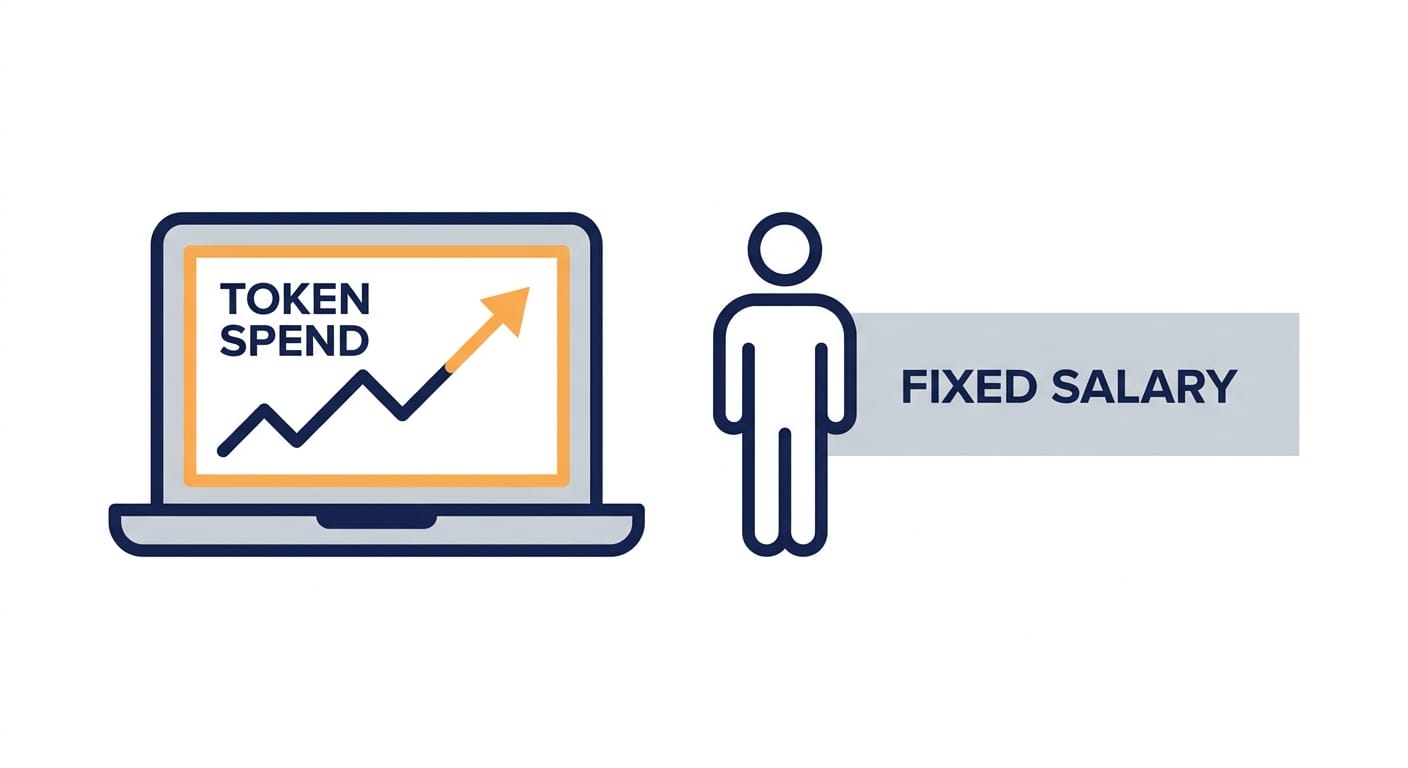
When you hire a person, you usually pay a predictable amount each month.
When you “hire” AI, you’re paying for a stack of things that behave like a utility bill:
- Tokens (usage-based text generation)
- Inference (every time the model runs)
- Licensing / seat fees (which have risen 20%–37% YoY in some AI software categories)[2]
- Infrastructure overhead (data pipelines, vector databases, monitoring, security)
- Quality control (humans you still need)
And that’s why you’re seeing headlines like:
- Nvidia VP Bryan Catanzaro saying compute costs exceed personnel costs for his team.[1]
- Uber’s CTO reportedly burning through their entire 2026 AI budget by Q2 because of token costs.[1]
Look, I’ll be honest… the “AI is cheaper” story is often based on demo math, not production math. Demos are like Costco samples: delicious, free, and not representative of your monthly grocery bill.
So what does “AI costs more than humans” actually mean?
It doesn’t mean AI is useless. It means AI’s unit economics are still weird, uneven, and easy to mess up.
What most people miss: cost-per-outcome is the only number that matters
Instead of asking, “Can AI do this job?” ask:
- What does it cost per resolved ticket?
- What does it cost per published article?
- What does it cost per qualified lead?
Gartner has warned that generative AI cost per resolution could exceed $3 by 2030—potentially higher than offshore human agents.[2] That’s not a guarantee, but it’s a strong hint that “AI = cheaper support” is not a law of physics.
And it’s not just chatbots
An MIT-related analysis found AI is economically viable in only 23% of vision-based roles—meaning 77% are still cheaper for humans when you compare total costs.[2]
The Bottom Line (mid-post TL;DR):
AI can absolutely create leverage. But today, it often works best as augmentation (making your people faster) rather than replacement (removing your people entirely).[2][4]
Solution: run AI like a business input, not a magic trick
If you’re an entrepreneur or marketer, you don’t need a PhD in GPUs. You need a simple operating model that prevents cost explosions.
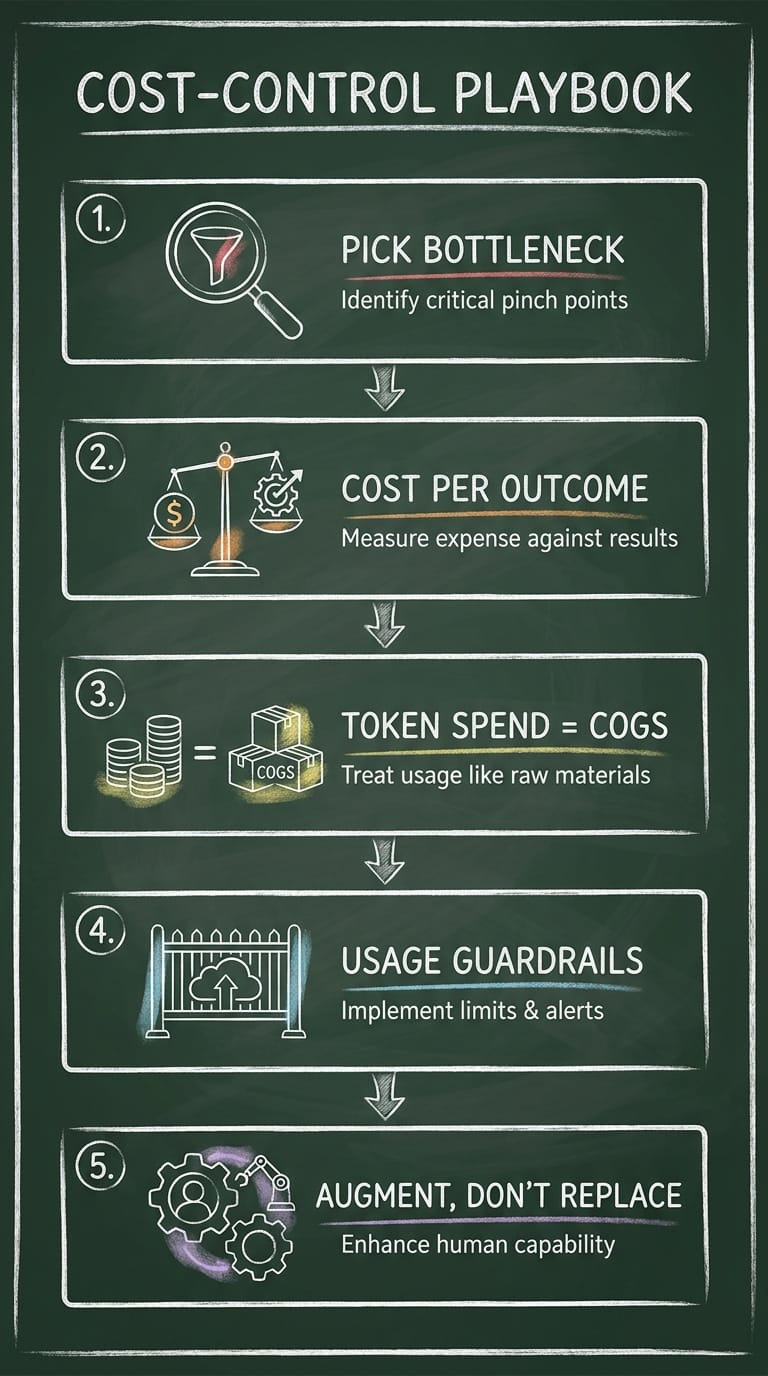
Here’s a practical 5-step playbook
- Pick one bottleneck, not a whole workflow. Start where humans are slow and the work is repetitive (drafting, summarization, tagging, support triage).[4]
- Calculate “cost per outcome” before you scale. Don’t measure “time saved” in a vacuum—tie it to a business result (publish, resolve, close, ship).
- Treat token spend like COGS. If usage goes up with customers, your AI bill behaves like cost of goods sold—not a fixed tool subscription.[1][2]
- Put guardrails on usage. Rate limits, smaller models for simple tasks, caching, and “human approval” steps keep you out of runaway-bill territory.
- Design for augmentation, not headcount reduction. Hybrid systems often beat pure automation because edge cases and quality still matter.[4]
Caption: If you do nothing else, do these five things before you scale AI.
Common mistakes (aka how AI bills get stupid)
- Rolling out “always-on” agents everywhere. Always-on equals always-billing. That’s great for your vendor. Less great for your margins.
- Using the biggest model for every task. That’s like using a moving truck to deliver a pizza.
- Ignoring fee inflation. AI software fees rising 20%–37% YoY means “we’ll just add more seats” can quietly turn into “why is our burn up?”[2]
Expert insight (the part the hype skips)
Axios reported Nvidia’s Bryan Catanzaro describing a reality many teams are running into: compute can cost more than the people using it.[1] That should change how you pitch AI internally. You’re not “eliminating labor cost.” You’re often trading labor cost for compute cost—and adding some new overhead.
FAQ
Is AI going to get cheaper over time?
Probably, yes. Gartner has suggested inference costs could drop 90%+ by 2030, following a maturation curve similar to solar panels.[2] But betting your 2026 margins on 2030 pricing is… ambitious.
Why are companies spending so much if the ROI is shaky?
Because the strategic stakes are huge. Big Tech reportedly invested $740B this year (up 69% from 2025) while also doing 92,000+ layoffs.[2] They’re building capacity for a future they believe will matter—even if today’s unit economics are messy.
What should a small business do right now?
Use AI to remove bottlenecks (draft faster, summarize faster, triage faster), and keep humans in the loop where quality impacts revenue. Don’t try to “AI-ify” the entire company on day one.[4]
Quick recap (so you don’t overthink it)
- AI often costs more than humans today because it’s metered compute plus overhead, not a fixed salary.[1][2]
- The right metric is cost per outcome, not “cool demo per minute.”
- Use AI for specific bottlenecks, treat token spend like COGS, and optimize for augmentation.[2][4]
Thought-provoking question to end on: if your AI costs doubled next month, would your revenue double too—or would your margins just quietly evaporate?
Citations: [1] Axios reporting cited in provided research summary (compute/token costs exceeding expectations; Uber budget claim; Nvidia VP quote). [2] Gartner / Federal Reserve-based adoption and cost claims cited in provided research summary (18% adoption by end of 2025; $3 per resolution projection; 90%+ inference cost drop; $740B capex; AI software fees up 20%–37%; MIT-related 23% viability figure). [4] Practical interpretation guidance from provided research summary (augmentation, bottlenecks, hybrid systems outperform blanket replacement).