Lead Magnets Aren’t PDFs Anymore (AI Turned Them Into Apps)
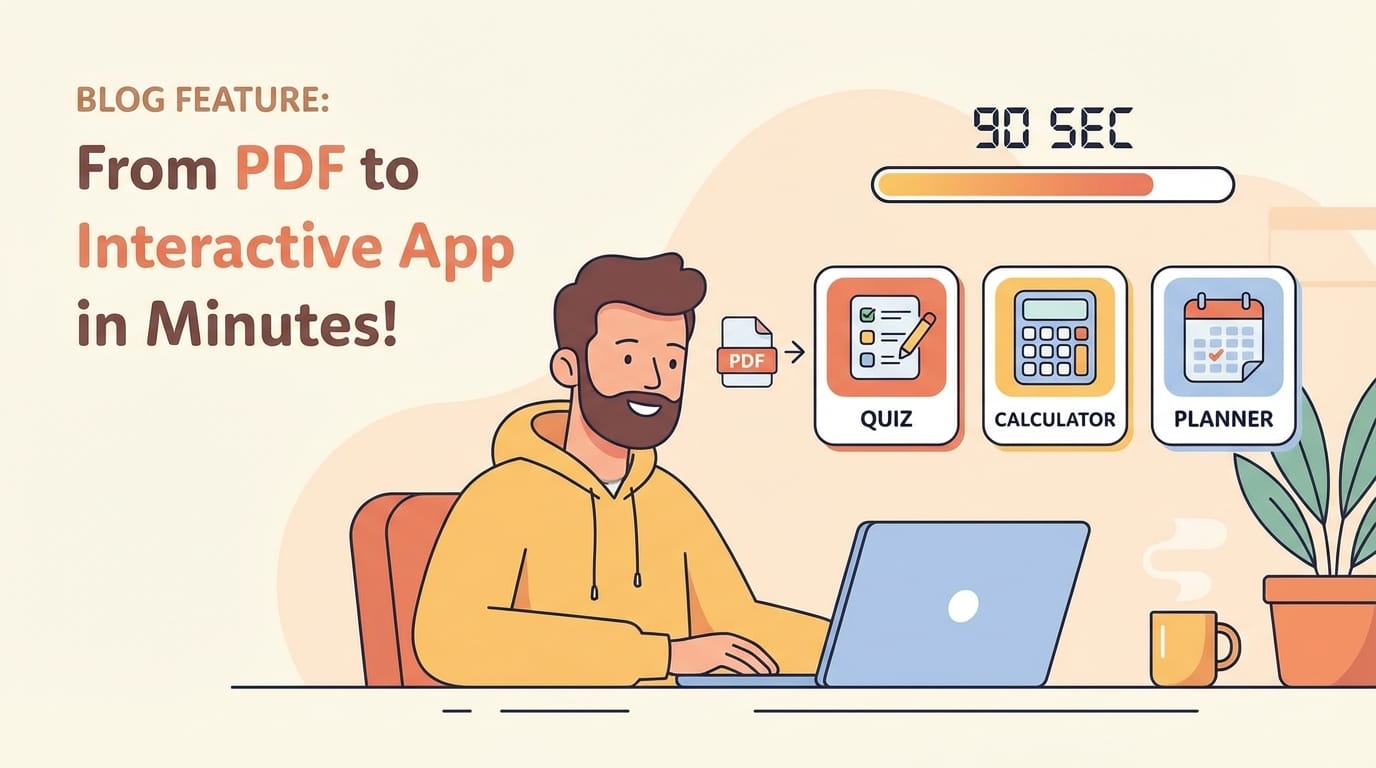
Remember when making a lead magnet meant opening Canva, staring at a blank page, and pretending you enjoy choosing fonts? Yeah… me too. You’d spend an hour (or six) building a “10-Step Checklist” PDF, slap a form on your site, and call it a day.
That whole workflow is getting steamrolled by AI.
And honestly? I’m not mad about it. Because the goal was never “make a pretty PDF.” The goal was always: get the right people to raise their hand. AI just made that faster, more measurable, and (here’s the real kicker) way more interactive.
So let’s talk about what’s actually changing, why lead magnet apps are the new default, and how you can use them without turning your brand into generic AI oatmeal.
First: What a Lead Magnet Used to Be
Traditionally, a lead magnet was:
- a PDF checklist
- an ebook nobody finished
- a template someone downloaded and never opened
And making one was… work. Even if you knew what you were doing, you’d still spend 45–90 minutes in Canva just to get something decent-looking, and 4–6 hours if you wanted it to be more than a sad bullet list with stock icons. That’s not me being dramatic—that’s the reality most marketers lived in. And for what? A file that sits in someone’s downloads folder next to “resume_final_FINAL2.pdf.”
AI Didn’t Just Speed Things Up — It Changed the Format
Here’s the big shift: AI isn’t only making lead magnets faster to create. It’s changing what we create.
Instead of “download this PDF,” we’re moving toward “use this tool.”
Why? Because interactive stuff converts. Always has. If someone inputs their info and gets a personalized result, they’re not just downloading—they’re engaging. They’re investing. They’re basically telling you, “Hey, this matters to me.”
And AI makes interactive lead magnets stupidly easy to build now.
Speed: From Half a Day to 90 Seconds
Let’s start with the obvious win: time.
New AI lead magnet apps can crank out a conversion-optimized magnet in under two minutes. Magnetly.co, for example, claims it can generate a finished lead magnet in about 90 seconds—a 96% time reduction compared to traditional methods. That’s not “slightly faster.” That’s “I made this while my coffee brewed.” [1]
And speed isn’t just about being lazy (although I’m not judging). Speed changes strategy. If you can create 10 versions in an afternoon, you can actually test things instead of guessing.
Old world: “We spent five hours on this PDF so please god let it convert.”
New world: “Cool, version A got 18% opt-in, version B got 31%. Ship B.”
Conversion-First Design: The Tool Is Now Your Annoying (But Right) Marketing Friend
This is where AI lead magnet apps get spicy.
Tools like Magnetly aren’t trying to be Canva. They’re not saying, “Here’s a blank canvas, go express yourself.” They’re saying, “Here’s what converts. Don’t fight me.”
Magnetly leans into what they call Conversion-First Design—basically, the layouts, headlines, CTAs, and structure are guided by patterns learned from analyzing 10,000+ campaigns. It’s “opinionated design,” which is a polite way of saying it won’t let you do dumb stuff that looks pretty but converts like a brick. [1]
And I’m going to take a stance here: most people need that constraint.
Because if you’re building lead magnets like art projects, you’re missing the point. A lead magnet is a conversion asset. It should be engineered like one.
Mobile Isn’t Optional Anymore
Another thing these apps bake in: mobile optimization.
Magnetly notes that about 73% of downloads happen on mobile. So if your PDF is basically unreadable on a phone (you know the ones), you’re bleeding conversions. The newer AI tools auto-adapt layouts for mobile so you don’t have to manually redesign everything. [1]
Ask yourself: when was the last time you opened a PDF on your phone and thought, “Wow, this is delightful”? Exactly.
PDFs Are Declining. Quizzes and Tools Are Taking Over.
Static PDFs aren’t dead, but they’re definitely not the main character anymore.
Interactive lead magnets—quizzes, calculators, planners, “get your personalized plan” flows—are winning because they do three things PDFs can’t:
- They personalize instantly (which feels like magic to the user).
- They collect better data (you learn what the lead actually wants).
- They increase completion rates (people like clicking buttons more than reading pages).
Tools like ScoreApp and Interact push quiz-based lead capture because engagement is higher than “here’s a PDF, good luck.” [4] [9]
And then you’ve got platforms like RightBlogger Tool Studio that let you build embeddable AI tools—think task breakdown assistants, meal planners, mini-assessments—without coding. You basically define the prompts and UI, and boom: your website has a useful tool that captures leads. [2]
That’s the shift in one sentence: lead magnets are becoming mini-products.
So… What’s a “Lead Magnet App,” Really?
When I say “lead magnet app,” I mean a specialized tool that handles the full workflow:
- generates the content
- designs it using proven conversion patterns
- creates multiple formats (smart PDFs, quizzes, tools)
- connects to your email system
- supports iteration and sometimes A/B testing
Magnetly, for instance, includes 250+ templates, supports A/B testing, and integrates with 500+ tools for delivery automation. Pricing starts around $29/month for unlimited creation. [1]
That’s not a design tool. That’s an assembly line for lead capture.
The Catch: AI Will Happily Produce Generic Garbage If You Let It
Here’s the part people don’t want to hear: AI doesn’t fix unclear marketing.
If your offer is fuzzy, your audience definition is “anyone with a pulse,” and your positioning is “we help you grow,” AI will generate something that sounds like it was written by a LinkedIn motivational poster.
The best practice that keeps coming up is hyper-specific prompting. You have to feed the tool real context: who it’s for, what they’re struggling with, what outcome they want, what tone you use, what you believe. [4]
Think of AI like a sous-chef. It’ll chop, prep, and plate fast—but you still need to be the one who knows what dinner you’re making.
What I’d Do If I Were Starting From Scratch in 2026
If you want the practical playbook, here’s mine:
1) Stop making “general” lead magnets
Pick one painfully specific problem and solve it fast.
Good: “The 7-minute onboarding checklist for B2B SaaS founders who hate churn.”
Meh: “The Ultimate Business Growth Guide.”
2) Choose the format based on the job
- If you need segmentation data: use a quiz (ScoreApp/Interact). [4] [9]
- If you need speed + volume testing: use an AI conversion-first generator (Magnetly). [1]
- If you want a sticky website asset: build an embeddable AI tool (RightBlogger Tool Studio). [2]
3) Build 3 versions and actually test them
AI makes iteration cheap. Use it. Try different hooks:
- “Get the plan”
- “Find your score”
- “Fix this in 10 minutes”
4) Automate delivery like you mean it
If your lead magnet doesn’t immediately trigger the right email sequence, you’re wasting the moment of highest intent. Connect it to ConvertKit/Mailchimp/etc. via native integrations or Zapier-style connectors. Magnetly supports a ton of integrations, so there’s no excuse to manually send stuff anymore. [1]
5) Use the inputs to personalize follow-up
This is the hidden superpower of interactive magnets. If someone tells you they’re a beginner, don’t send them the “advanced tactics” email. If they say their biggest issue is time, don’t pitch them a 12-week program with daily homework.
AI can help you audit this too—like analyzing why leads aren’t converting and suggesting follow-up improvements. [3]
My Take: Lead Magnets Are Becoming “Try-Before-You-Buy” Experiences
I think we’re heading toward a world where the best lead magnets feel like tiny products:
- a personalized plan
- a score and recommendation
- a generated template based on their inputs
That’s why tools like The Leap talk about AI authoring that can double or triple list growth faster—because the magnet is more tailored and more immediate. [7]
And yeah, PDFs will still exist. But they’ll be the “printable version” of something interactive, not the main event.
Actionable Takeaways (Do This Next)
- Pick one problem your audience wants solved this week, not “someday.”
- Choose an app, not a blank canvas: try Magnetly for fast conversion-first assets, or ScoreApp/Interact for quizzes, or RightBlogger Tool Studio for embeddable tools. [1] [2] [4] [9]
- Create 3 variations and test the hook + CTA. Don’t marry version one.
- Make it mobile-proof by default (most people will engage on their phone). [1]
- Automate delivery + follow-up so every opt-in triggers the right sequence immediately. [1]
Sources
- Magnetly.co research summary: AI-driven Conversion-First Design, 90-second creation time, 10,000+ campaign patterns, mobile optimization (73% downloads), A/B testing, integrations, pricing (~$29/mo). (Early 2026 data)
- RightBlogger Tool Studio: no-code embeddable AI tool builder using customizable prompts; examples include planners and task breakdown tools. (Early 2026 data)
- AI best practices: audit/iterate prompts for diagnosing conversion drop-off and improving follow-up sequences. (Early 2026 data)
- ScoreApp: emphasizes quizzes and strategic prompts for higher engagement vs static PDFs; AI-assisted creation. (Early 2026 data)
- Interact: quiz-based lead magnets for interactive lead capture. (Early 2026 data)
- The Leap: AI authoring positioned to accelerate email list growth with tailored magnets. (Early 2026 data)