Claude Code + the “Ask Anything” Prompt: My No-BS Way to Build a Better Plan
Claude Code gets you from idea to implementation fast—but the “Ask Anything” prompt is what makes the plan real. Here’s my simple workflow to surface unknowns, stress-test assumptions, and ship with fewer surprises.

Here’s my hot take: most “plans” are just fancy fanfiction. They look amazing in a doc… right up until reality shows up with a baseball bat. If you’ve ever shipped software (or tried to), you know exactly what I mean.
The trick isn’t writing a prettier plan. It’s building a plan that survives contact with the real world—messy requirements, stakeholders changing their minds, and the news cycle reminding you that “external risk” isn’t theoretical anymore.
That’s where Claude Code and what I call the “Ask Anything” prompt come in. Together, they act like a brutally honest co-founder: they’ll help you surface unknowns, stress-test assumptions, and turn a vague idea into an execution-ready roadmap.

The real problem: planning is easy when you ignore the hard parts
Most planning failures aren’t about effort. They’re about missing questions.
Teams usually plan like this:
- Write a goal
- List some tasks
- Pick a deadline that “feels right”
- Hope the dependencies behave
But the world’s gotten more chaotic. Conflicts and disruptions are actively knocking out infrastructure and destabilizing regions—like fresh strikes in Ukraine leaving hundreds of thousands without power and heat during freezing temps—and that kind of volatility spills into supply chains, staffing, policy, and risk planning whether you like it or not. The UN has also warned about surging internet shutdowns (300+ incidents in 54 countries over two years), which is a nice way of saying: “Your cloud app may not be reachable in places you care about.” [1]
So yeah—your plan needs to include reality. Not just Jira tickets.
The solution: pair Claude Code with an “Ask Anything” prompt
Claude Code (in plain English) is Claude operating in a developer-friendly way—helping you reason through architecture, write/modify code, generate tests, and think in systems. It’s not magic. It’s a very fast, very patient collaborator that’s good at turning ambiguity into structure.
The “Ask Anything” prompt is the part most people skip. They ask for a plan, get a plan, and stop. But the better move is to explicitly invite the model to interrogate your idea before it commits to answers.
Because what do great human operators do? They ask annoying questions. Lots of them.
How I actually do it (step-by-step)
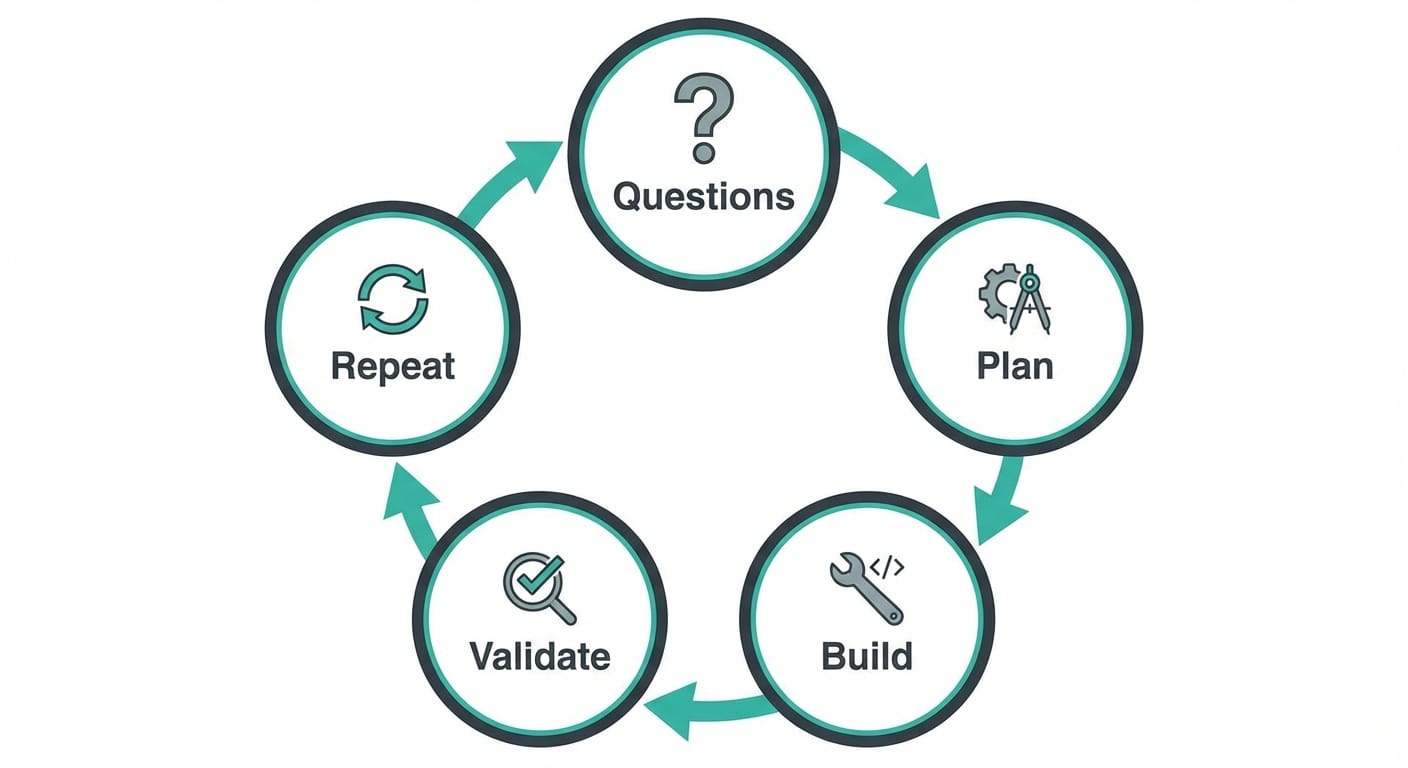
This is my workflow when I want a plan that’s not brittle.
- Start with the outcome, not the feature list.Example: “Reduce customer onboarding time from 3 days to 30 minutes.”
- Tell Claude Code your constraints.Budget, stack, team size, compliance, timeline, “we can’t break production,” etc.
- Run the “Ask Anything” prompt.You want Claude to dump every clarifying question it can think of. Then you answer what you can, and flag what you can’t.
- Ask for a plan that’s explicit about unknowns.I want callouts like: “Assumption: X. Risk if wrong: Y. Validation: Z.”
- Translate the plan into code-adjacent artifacts.Interfaces, data models, test cases, monitoring, rollback strategy—stuff that forces reality checks.

The “Ask Anything” prompt (steal this)
Here’s a version I’ve used (tweak it to your taste):
You are my planning partner. Before proposing a solution, ask me anything you need. Context: [describe product/project] Goal: [measurable outcome] Constraints: [team, stack, budget, timeline, compliance] Task: 1) Ask 15-25 clarifying questions. Be specific and challenge assumptions. 2) Group questions by: users, data, architecture, security/privacy, delivery, risks/dependencies. 3) After I answer, produce: - A phased plan (MVP → V1 → V2) - A risk register (impact/likelihood/mitigation) - Validation checklist (how we prove assumptions) - A “what could go wrong” section Keep it practical and execution-ready. Pro Tips (the stuff that actually makes this work) Pro Tips Box
- Force tradeoffs. Tell Claude: “If we can only ship 3 things, which 3 and why?”
- Demand acceptance criteria. Every milestone should have “done means…”
- Make it budget-aware. Ask for a “cheap version” and a “proper version.”
- Ask for failure modes. I love: “List 10 ways this plan fails in production.”
Common mistakes (don’t do this)
- Mistake #1: Asking for a plan too early.If you haven’t answered the annoying questions, your plan is just vibes.
- Mistake #2: Treating global risk as “someone else’s problem.”Internet shutdowns, instability, and infrastructure disruptions can affect vendors, users, and uptime. The UN’s reporting on shutdowns is a wake-up call for anyone building connected products. [1]
- Mistake #3: No validation loop.If assumptions aren’t tested fast, they calcify into expensive mistakes.
Case study snippet: shipping a “crisis-aware” status feature
Let’s say you run a SaaS product with customers in multiple regions. You want a better incident/status experience that doesn’t fall apart when connectivity is spotty.
Claude Code + “Ask Anything” will surface questions like:
- Do we need an offline-friendly status page?
- What’s our comms fallback if social platforms or parts of the internet are blocked?
- Do we have regional dependencies (CDNs, SMS gateways) that could be impacted?
That connects directly to the real world: if internet shutdowns are increasing globally, then “our app assumes always-on internet” is a risky assumption for certain users. [1] You don’t need to boil the ocean—maybe you just ship email/SMS fallbacks, cache the last known status in-app, and make incident comms resilient.
Sources
- [1] UN reporting on global crises and risks, including Ukraine strikes affecting utilities and internet shutdown trend (300+ incidents in 54 countries over two years), as provided in the research data.
- [2] Additional global incident and economic developments referenced in the research data (exports, disasters, regional attacks), as provided.
- [3] Reporting on Gaza strikes (Jan 21) and related geopolitical developments, as provided in the research data.
- [4] Reporting on protests and migration policy impacts, as provided in the research data.
Action challenge
Pick one project you’re working on right now and run the “Ask Anything” prompt today. Then do the uncomfortable part: answer the questions you can, and for the ones you can’t, create a validation task (interview, spike, prototype, data pull) and schedule it this week.
Because a plan that can’t survive questions? That’s not a plan. That’s a wish.