Apple + Google = Smarter Siri? Yep, That Just Happened
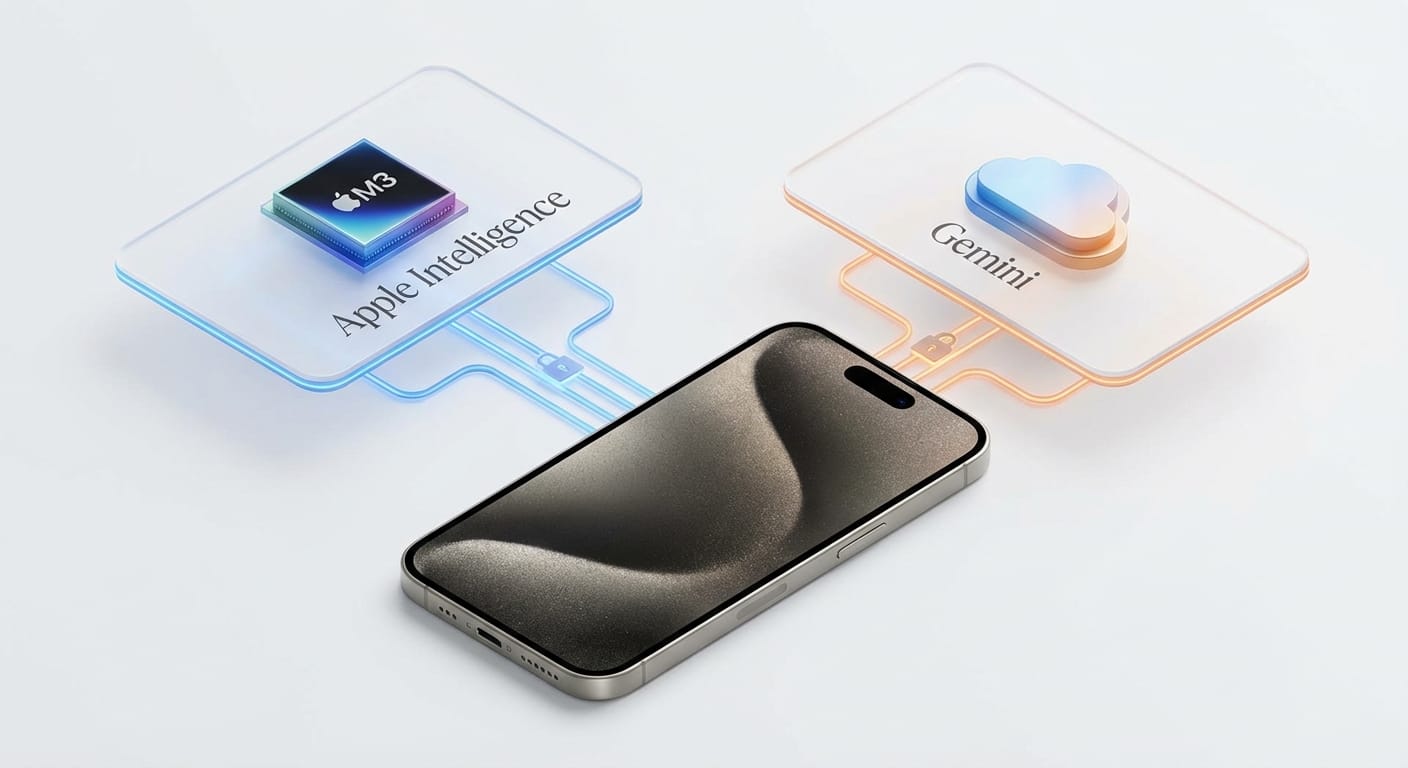
Apple just did the thing Apple almost never does: it picked a partner to power something core to the iPhone experience. And not just any partner—Google. Yep, Apple is teaming up with Google to use Gemini as the foundation for Apple Intelligence, with a more personalized Siri slated for later in 2026. [1][3]
If your first reaction is, “Wait… Apple and Google are friends now?”—same. But once you unpack the “why,” it starts to make a ton of sense (and also raises a few very fair questions).
What actually got announced?
Here’s the clean version without the keynote confetti:
- Apple and Google signed a multi-year partnership where Gemini models + Google cloud tech will underpin Apple’s next-gen foundation models used in Apple Intelligence features. [3]
- This is part of what enables a more personalized Siri, currently targeted for later in 2026. [1][3]
- The deal is not exclusive—Apple can still plug in other models later. [1]
- ChatGPT stays available, but it’s opt-in for specific tasks, not the default “engine.” [1]
In their joint statement, Apple basically said: we evaluated options, and Google’s AI tech was the most capable foundation for what Apple wants to build. [3] That’s a pretty big compliment, coming from the company that usually prefers to build everything in-house… down to the screws.
Why would Apple do this (instead of building it all themselves)?
I’m going to take a stance here: Apple didn’t partner because it wanted to—it partnered because it had to.
AI isn’t like building a new camera module or designing a chip where Apple can out-execute everyone with enough time and money. Modern foundation models are more like running a massive shipping port: you need infrastructure, scale, constant iteration, and a ridiculous amount of data and compute.
Could Apple do it alone? Eventually, sure. But here’s the problem: Siri has been “eventually” for like a decade. And the AI race doesn’t wait politely while Apple perfects the edges.
The reporting also points out Siri upgrades had slipped from earlier targets, and this partnership accelerates that timeline. [1][2] Translation: Apple wants Siri to stop being the punchline at tech dinners.
Analogy time: this is Apple buying the engine, not the whole car
Think of Apple Intelligence like a car Apple’s designing. Apple still controls the dashboard, the safety systems, the materials, the user experience—the stuff Apple is freakishly good at. But Gemini is the engine under the hood. You can still tune it, wrap it, and put a premium interior on it… but it’s hard to ignore where the horsepower comes from.
What does “Gemini as the foundation” mean for you?
It means Siri should get better at the stuff we actually care about:
- Understanding context (what you mean, not just what you said)
- Handling multi-step tasks without falling apart
- Being more personal (without you having to repeat yourself 14 times)
And yes, Apple specifically called out a more personalized Siri coming later in 2026. [1][3] That’s a big deal—because “personal” is where Siri has historically been… how do I say this politely… not great.
Also worth noting: the arrangement is non-exclusive. [1] So Apple is leaving the door open to swap in other models over time. That’s smart. Locking yourself to one AI provider right now is like marrying the first smartphone you ever owned.
But what about privacy? (Because it’s Apple, so we have to ask)
If you’re thinking, “Hold up—Google plus my iPhone sounds like a data smoothie,” you’re not alone.
Apple’s message is clear: its privacy architecture remains intact. Processing will still happen on-device or through Apple’s Private Cloud Compute infrastructure. [1][3]
In other words, Apple’s trying to keep the same privacy story:
- Do as much as possible on your device
- When it can’t, use Apple-controlled cloud with privacy safeguards
- Don’t turn your phone into an ad-targeting confession booth
Will regulators in the EU and UK poke at this? Almost definitely. Apple even expects privacy-first design to be a key message in those communications. [1] Honestly, it’s probably the only way Apple can pull this off without setting off alarms across half the planet.
So… is this bad news for OpenAI?
Not catastrophic, but it’s not a win either.
ChatGPT remains integrated as an opt-in option for specific tasks, but it’s not the default foundation. [1] If you’re OpenAI, you’d obviously prefer to be the engine, not the optional add-on.
The market read it that way, too. The announcement helped fuel a big moment for Google—Alphabet briefly hit a $4T valuation on Jan 12, 2026, with analysts pointing to the Apple partnership as validation of Google’s AI strategy. [1]
So yeah: this is a clear signal that Google’s AI is considered “safe enough” and “good enough” for Apple to bet Siri on. That’s huge.
What I think this means (the practical version)
I’ll keep it real: I’m cautiously optimistic.
On one hand, Apple partnering with Google could finally deliver the Siri we’ve wanted since… I don’t know… the Obama administration. On the other hand, any time two giants team up, you should assume it’s because it benefits the giants first.
But for users and builders, there are a few very practical implications:
1) The next Siri might actually be a real assistant
If Apple executes, Siri could move from “voice command tool” to “task orchestrator.” Think: coordinating apps, summarizing what matters, and handling messy human requests without rage-quitting.
2) AI on phones is going hybrid
We’re heading into a world where the best experience is a blend:
- On-device for speed + privacy
- Private cloud for heavier lifting
- Model partners for state-of-the-art reasoning and language
This partnership is basically Apple saying: “We’ll own the experience, but we’ll borrow the rocket fuel.”
3) If you build apps, expect Siri to matter again
If Siri becomes meaningfully smarter in 2026, developers should expect Apple to push harder on voice- and intent-driven flows. If you’ve ignored Siri integrations because they felt pointless, you might want to revisit that stance.
Actionable takeaways (because what do we do with this info?)
- If you’re an iPhone user: Pay attention to the privacy settings around Apple Intelligence and any opt-in model features. Don’t blindly enable everything just because it’s shiny.
- If you work in product/UX: Start designing for “intent,” not taps. Smarter assistants change how people navigate apps.
- If you’re a developer: Watch Apple’s Foundation Models and Siri capabilities closely. A capable Siri could become a distribution channel again—like Spotlight, but conversational.
- If you’re in business/strategy: Take note that “vertical integration forever” isn’t a law of physics. Even Apple partners when timelines and capability gaps get real.
Bottom line: Apple teaming up with Google for Gemini-powered Apple Intelligence is a big swing. If it works, Siri stops being the butt of jokes and becomes something people actually use on purpose. If it doesn’t… well, Siri will still be great at setting timers. And honestly, she’s had a strong career there.
Sources
[1] Research brief provided (Industry reporting on Apple/Google Gemini partnership, non-exclusive terms, privacy positioning, market impact, timeline to 2026)
[2] Research brief provided (Prior reporting on potential ~$1B financial terms and Siri schedule slippage)
[3] Research brief provided (Joint Apple/Google statement: Gemini models + cloud underpin Apple Foundation Models; privacy via on-device and Private Cloud Compute)