What If Your AI Ran on Nuclear Power? Yeah… That’s Happening
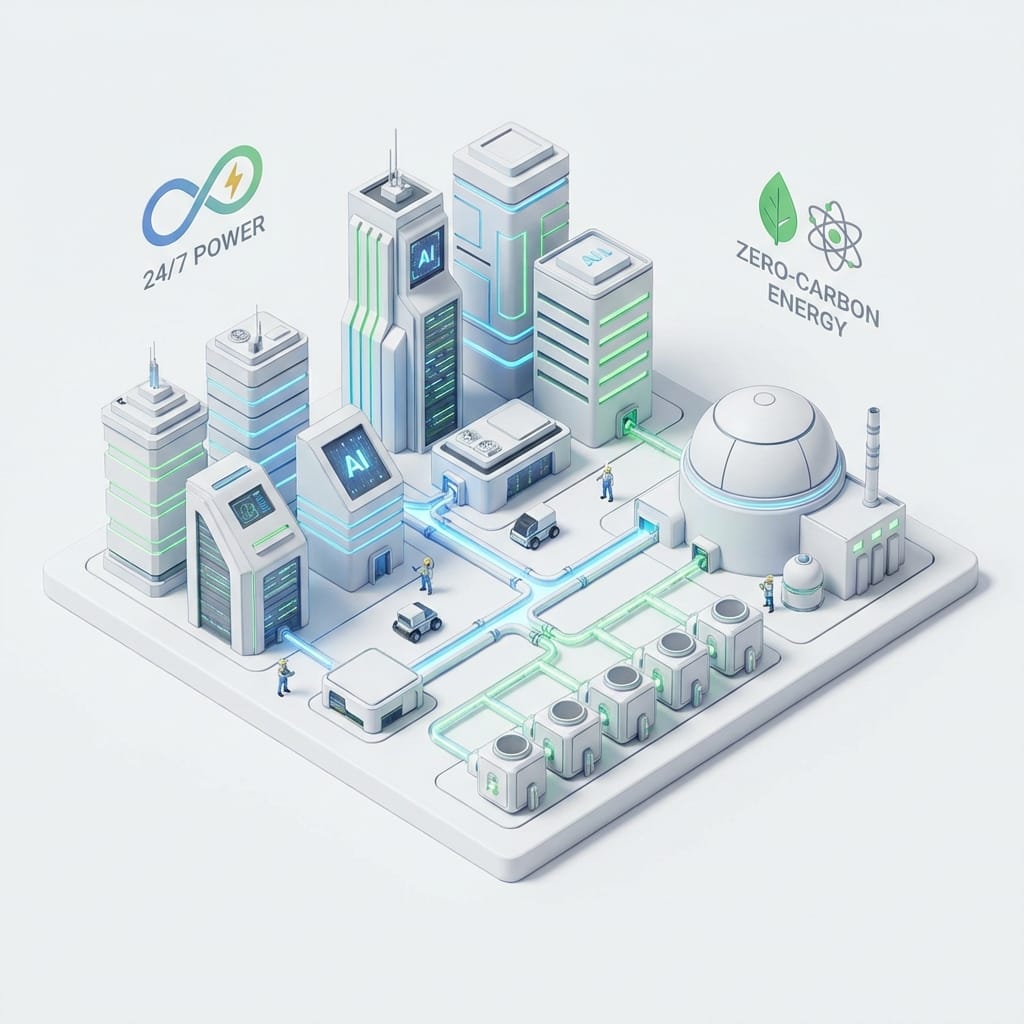
Let’s play a quick game of “spot the trend.” AI models are getting bigger. Data centers are multiplying like rabbits. And everybody wants it all to be “zero carbon” and reliable and cheap. Cool cool cool.
So here’s the twist: a bunch of the biggest tech companies are quietly (and sometimes loudly) betting that the future of AI runs on… nuclear power.
And before you picture glowing green goo and Homer Simpson dozing off at the console—modern nuclear is basically the opposite of that. What’s really going on is pretty straightforward: AI needs a ridiculous amount of electricity 24/7, and nuclear is one of the few sources that can do “always on” power without dumping CO₂ into the atmosphere.
Why AI is suddenly obsessed with electricity
AI isn’t “just software.” It’s software sitting on top of warehouses full of GPUs that pull power like a small city. Training big models is energy-intensive, and inference (the part where millions of users ask questions every day) is also a constant drain.
Here’s the key point: data centers don’t want average power. They want guaranteed power. If you’re running an AI cluster, you can’t tell your customers, “Sorry, it’s cloudy today—try again tomorrow.”
That’s why the International Energy Agency (and plenty of grid folks) keep hammering on the idea that data centers are going to become one of the defining electricity challenges of this decade. In fact, one analysis notes US AI power use could surpass the combined consumption of heavy industries like aluminum, steel, cement, and chemicals by the end of the decade. That’s… bonkers. And also totally plausible. [2]
So why nuclear, specifically?
Let me put it in everyday terms: wind and solar are like a great part-time team—cheap, clean, but not always clocked in. Nuclear is like the calm, boring, dependable night shift that never calls out.
For AI data centers, “boring” is a feature.
Nuclear checks three boxes AI can’t stop talking about
- Always-on power (baseload): Nuclear plants run 24/7 for long stretches, which matches how data centers operate. [2]
- Low carbon: If you’re a hyperscaler promising carbon-free operations, nuclear is one of the easiest ways to back that up with real electrons. [2]
- High density: You can get a lot of power from a relatively small footprint—useful when you’re trying to feed an energy-hungry compute campus. [2]
Now, to be clear: I’m not saying renewables aren’t part of the solution. They absolutely are. But betting your AI uptime on sunshine is like betting your restaurant’s dinner rush on “maybe the oven will feel like working today.”
The big tell: tech companies are signing 20-year nuclear deals
If you want to know what companies really believe, don’t read their blog posts. Follow their contracts.
And the contracts are getting spicy.
Meta: going big (like, 6.6 GW big)
In January 2026, Meta announced deals that could unlock up to 6.6 gigawatts of nuclear power for AI. The headline piece: a 20-year PPA with Vistra for 2,600 MW from Beaver Valley (Pennsylvania) plus two Ohio plants (Perry and Davis-Besse), along with 433 MW of new generation. Meta says that’s enough for over 300,000 homes, and the deal helps extend licenses for 20 years and create about 3,000 jobs over nine years. [1] [4] [6]
Meta also signed up for 1,200 MW from Oklo’s planned new reactor in Ohio (targeted by 2034) and 690 MW tied to TerraPower reactors (site TBD). [1] [4]
My take? Meta isn’t “exploring” nuclear. Meta is locking it in. That’s a very different posture.
Microsoft: the Three Mile Island comeback tour
Microsoft signed a 20-year deal connected to restarting Three Mile Island Unit 1 in Pennsylvania, which was previously shuttered. Yes, that Three Mile Island. Not the infamous unit—Unit 1. Still, it tells you how serious the power crunch is when a hyperscaler helps bring a plant back online. [1] [2]
Google: SMRs now, space solar later (because why not?)
Google agreed to buy power from multiple small modular reactors (SMRs) expected to be operational by 2030, and they’re also poking at space-based solar with prototype satellites planned for 2027. That’s Google in a nutshell: one foot in practical procurement, one foot in sci-fi. [2]
Equinix: microreactors for data centers
Equinix preordered 20 Kaleidos microreactors from Radiant for data centers. Microreactors are like the “portable generator” version of nuclear—still early, but the direction is clear: put power closer to compute. [3]
Big reactors vs. SMRs vs. microreactors: what’s the difference?
If nuclear were a vehicle lineup:
- Large reactors are cargo ships. Massive output, proven tech, great when you can plug into existing sites and grid infrastructure.
- SMRs are like regional freight trucks. Smaller, theoretically faster to deploy, and easier to site near demand.
- Microreactors are more like delivery vans. Intended for smaller footprints and localized use cases—like a data center campus that doesn’t want to lean on a stressed grid.
The table stakes for AI are reliability and scale. That’s why we’re seeing both “restart the old plant” deals and “build new SMRs” bets happening at the same time. [2] [3]
Okay Marty, but is this actually realistic?
Mostly, yes—with caveats. Here are the two big ones I’m watching.
Caveat #1: AI demand might not grow as fast as the hype
One study suggests AI could be only about 25% of new grid demand by 2030. If that’s true, and if efficiency improves faster than expected, some nuclear projects could end up overbuilt or “stranded.” [3]
Translation: if the AI bubble deflates or chips get dramatically more efficient, the “we need ALL the power” narrative might cool off.
Caveat #2: SMRs are promising, but not fully proven at scale
SMRs are progressing, and regulators are paying attention, but a lot of the SMR story is still in the “moving from R&D to deployment” phase. In other words: real momentum, real money, still some execution risk. [2]
Why this nuclear-AI pairing could be bigger than it looks
Here’s the part people miss: this isn’t just about powering servers. It’s about reshaping how big infrastructure gets financed.
Tech companies have the balance sheets and long-term demand to sign PPAs that make nuclear projects financeable. The World Nuclear Association has talked about a “fleet view” approach—think scaled, repeatable deployments instead of one-off projects. Hyperscalers are basically acting like anchor tenants for clean baseload power. [5]
Also, it’s not just the US. There are 71 reactors under construction globally and 441 operating, with multiple countries expanding nuclear alongside AI growth. And there’s a broader pledge floating around to triple nuclear capacity by 2050. [2]
And yes, AI helps nuclear too—predictive maintenance, optimization, design workflows—the IAEA has highlighted this “mutual benefit” angle. [7]
What if AI really does run on nuclear power?
Then a few things happen:
- Data centers get more predictable: fewer grid constraints, less curtailment drama, more stable pricing (especially with long PPAs).
- Old plants get new life: restarts and license extensions become a big lever for near-term capacity. [1] [2]
- SMR ecosystems accelerate: if hyperscalers keep signing, suppliers and regulators will move faster (because money is a wonderful motivator).
- Public debate heats up: nuclear always comes with politics—waste, safety, siting, timelines. Expect louder conversations.
My stance: if you want 24/7 clean power for AI, nuclear is one of the few grown-up answers on the menu. Not the only answer—but one that actually matches the workload.
Actionable takeaways (aka what you should do with this info)
- If you run a company using AI heavily, start asking your cloud vendors about their energy mix and long-term capacity plans. “Carbon-free” marketing is cute; PPAs are real.
- If you invest (or you’re just curious), watch who’s signing 15–20 year energy contracts. That’s where the future is being quietly decided.
- If you build data center or infrastructure software, assume power constraints will be a core product requirement—load shifting, scheduling, energy-aware compute, and site strategy will matter more every year.
Sources
- Meta nuclear power commitments and related reactor deals (as summarized in provided research). [1]
- Industry reporting on tech firms pursuing nuclear/SMRs for AI data centers; global reactor counts and AI energy demand outlook (as summarized in provided research). [2]
- Equinix preorder of Radiant Kaleidos microreactors; note on AI demand uncertainty and potential stranded assets risk (as summarized in provided research). [3]
- Meta PPA details including 2,600 MW and additional agreements (as summarized in provided research). [4]
- “Fleet view” / demand-led nuclear financing shift (as summarized in provided research). [5]
- Plant license extensions and job creation figures tied to Meta-related nuclear agreements (as summarized in provided research). [6]
- IAEA perspective on nuclear meeting AI needs and AI supporting nuclear operations (as summarized in provided research). [7]