AI-Generated Content Isn’t the Problem — Lazy Publishing Is
AI-generated content isn’t the enemy. Publishing unedited, unsourced first drafts is. Here’s a practical 5-step workflow to make AI content fast, accurate, and unmistakably yours.

AI-generated content isn’t ruining the internet. What’s ruining the internet is people publishing the first draft like it’s a final draft. There’s a big difference.
Here’s the thing… AI is basically a power tool. In the right hands, it builds a house. In the wrong hands, it removes a thumb. And lately, a lot of folks are waving the tool around like a chainsaw in a bounce house.
So what’s the actual problem?

The pain point isn’t “AI content.” It’s unreviewed AI content. You’ve seen it: vague posts, confident wrong facts, filler paragraphs that say nothing, and the same “in today’s fast-paced world” line copy-pasted into oblivion.
And when the news cycle’s intense, that sloppiness gets dangerous. Like right now:
- A historic blizzard slammed the Northeast, with states of emergency and over 2,000 flight cancellations reported. People need accurate updates, not fluffy summaries. [Reuters]
- Gaza’s ceasefire situation is nuanced (Rafah reopening with strict limits, while strikes reportedly still killed dozens). That’s not a topic you “just vibe” your way through. [AP]
- Ukraine’s energy infrastructure attacks are triggering emergency outages nationwide—again, details matter. [BBC]
Here’s what most people miss… when the stakes are high, content is a product. If you ship it half-baked, you’re not “moving fast.” You’re shipping bugs into people’s brains.
The solution: a simple, repeatable workflow
Look, I’ll be honest… the biggest win with AI content isn’t “having AI write it.” It’s building a workflow where AI accelerates the boring parts and humans own the truth, voice, and judgment.
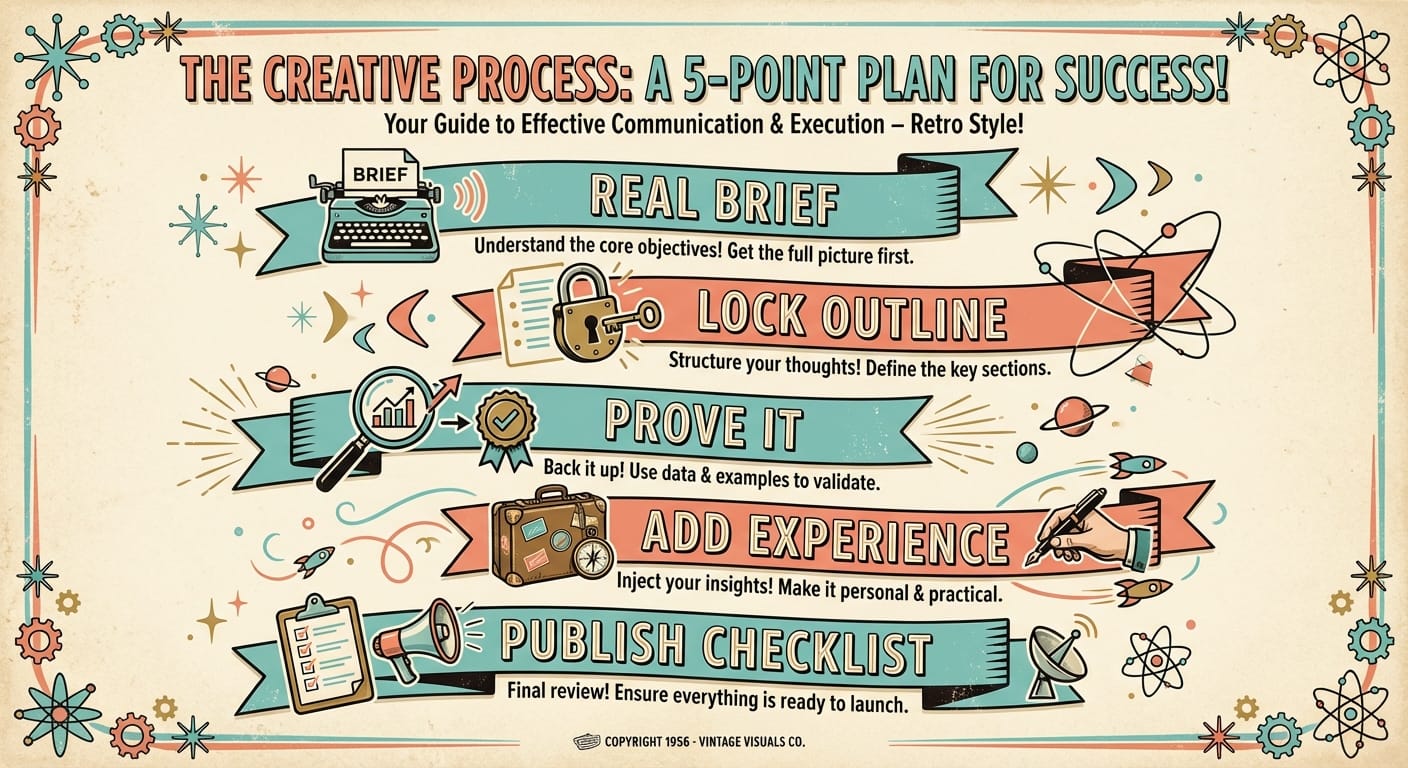
Here’s my practical 5-step process that keeps you fast and credible.
1) Start with a real brief (not a vibe)
If your prompt is basically “write a blog post about X,” you’re going to get beige wallpaper. Give AI constraints: audience, point of view, examples to include, what to avoid, and how you’ll measure success (traffic? signups? clarity?).
2) Generate an outline first, then lock it
Don’t let the model freestyle structure. Make it propose 2–3 outlines, pick one, and only then draft. This cuts waffle in half immediately.
3) Force specificity with “prove it” passes
After the draft, do a pass where you ask: “Which claims need a source?” and “Where are we being vague?” Add concrete numbers, named examples, and remove generic advice.
4) Add human experience (the part AI can’t fake well)
This is where your content stops sounding like everyone else. Add your “I tried this and here’s what happened” notes. Add the tradeoffs. Add the unpopular opinion.
5) Run a pre-publish checklist (every single time)

Yes, even if you’re in a hurry. Especially if you’re in a hurry.
Pro Tips Box: Make AI sound like you (not “a helpful assistant”)
- Keep a “voice doc.” 10–15 bullet points with phrases you use, jokes you’d make, and stuff you’d never say.
- Feed it your examples. AI is way better at remixing your stories than inventing believable ones.
- Ban filler. Literally tell it: “No clichés, no ‘delve,’ no ‘in conclusion.’”
- Do a “delete 20%” sweep. Most AI drafts are 20% longer than they should be.
Common mistakes (a.k.a. how people get roasted on LinkedIn)
- Publishing without fact-checking. If you mention current events (war, disasters, politics), cite sources and verify dates. Don’t guess.
- Fake confidence tone. AI loves certainty. Real experts use precise language: “reported,” “according to,” “as of Feb. 24.”
- Zero differentiation. If your post could be swapped with 10 competitors and nobody notices, it won’t perform.
- Forgetting the reader’s job-to-be-done. Are they trying to decide, buy, learn, or troubleshoot? Pick one.
FAQ
Is AI-generated content bad for SEO?
Not inherently. Search engines tend to reward helpful, original, accurate content. The problem is low-value bulk publishing, not the tool. (Google’s guidance focuses on content quality, not whether AI helped create it.) [Google Search Central]
Should I disclose that I used AI?
Depends. For many blogs, it’s not required, but for sensitive topics (finance, health, breaking news) transparency builds trust. If AI assisted, I’m generally pro-disclosure in an editor’s note.
How do I avoid hallucinations?
Don’t ask AI to “remember” facts. Give it the facts (with sources), then have it write. And if you can’t verify a claim quickly, cut it.
Where does AI help the most?
Outlines, first drafts, headline variations, summaries, repurposing, and turning internal notes into readable prose. The judgment calls? That’s still you.
Tool/Resource recommendations (the stuff I actually reach for)
- Perplexity / web-enabled research tools for source-backed starting points (still verify primary sources).
- Grammarly / LanguageTool for grammar cleanup, not meaning.
- Hemingway Editor for cutting fluff and improving readability.
- Airtable/Notion to store your voice doc, prompt templates, and content QA checklist.
Thought-provoking question
If AI can write 10 articles a day… what’s your competitive advantage going to be when everyone can? Speed is getting commoditized. Judgment isn’t. Are you building a content machine—or a credibility engine?
Sources: Blizzard impacts and flight cancellations (Reuters); Gaza ceasefire/Rafah reopening and strike reports (AP); Ukraine infrastructure attacks and outages (BBC); Google guidance on AI content and quality (Google Search Central).