AI-Generated Content: Useful, Risky, and (Honestly) Here to Stay
AI-generated content is a speed booster, not a substitute for thinking. Here’s Marty’s 5-step workflow to get high-quality output without wrecking trust—or SEO.

Imagine this: you’ve got a blog post due in two hours, a product launch page that still says “Lorem ipsum,” and a CEO who just discovered the word “thought leadership.” You open ChatGPT, type a prompt, and boom—words appear like a slot machine that actually pays out.
So… is AI-generated content a cheat code, or is it secretly turning the internet into one giant copy-paste smoothie?
The real problem: speed is addictive, but trust is fragile

I’m pro-AI. Very pro. It’s one of the biggest leverage tools we’ve ever had for writing, ideation, customer support, docs, marketing—you name it. But here’s my hot opinion: AI content isn’t “done” when the model stops typing. That’s when your job starts.
Because the internet has two big constraints:
- Attention (people bounce fast)
- Trust (people don’t forgive fast)
AI helps with attention (more output, faster). But it can absolutely torch trust if you publish stuff that’s wrong, generic, or clearly written by a robot that’s never had to ship software on a deadline.
And yes, the robots hallucinate. Not “oops a typo” hallucinate. More like “confidently invent a law firm in Omaha that never existed” hallucinate.
OpenAI itself warns that models can produce incorrect information and that you should verify outputs, especially for important use cases (OpenAI Terms of Use; see also their general guidance across product docs). Google’s also been blunt: it doesn’t ban AI content because it’s AI—it targets low-quality or spammy content, regardless of how it’s produced (Google Search Spam Policies).
My practical stance: treat AI like a junior writer with turbo speed
If you hire a junior writer, you wouldn’t say, “Cool, publish whatever you want under my brand name.” You’d give them:
- a clear brief
- examples of your voice
- review and edits
- fact-checking expectations
- feedback loops
Same deal with AI. It’s not an author. It’s a drafting engine.
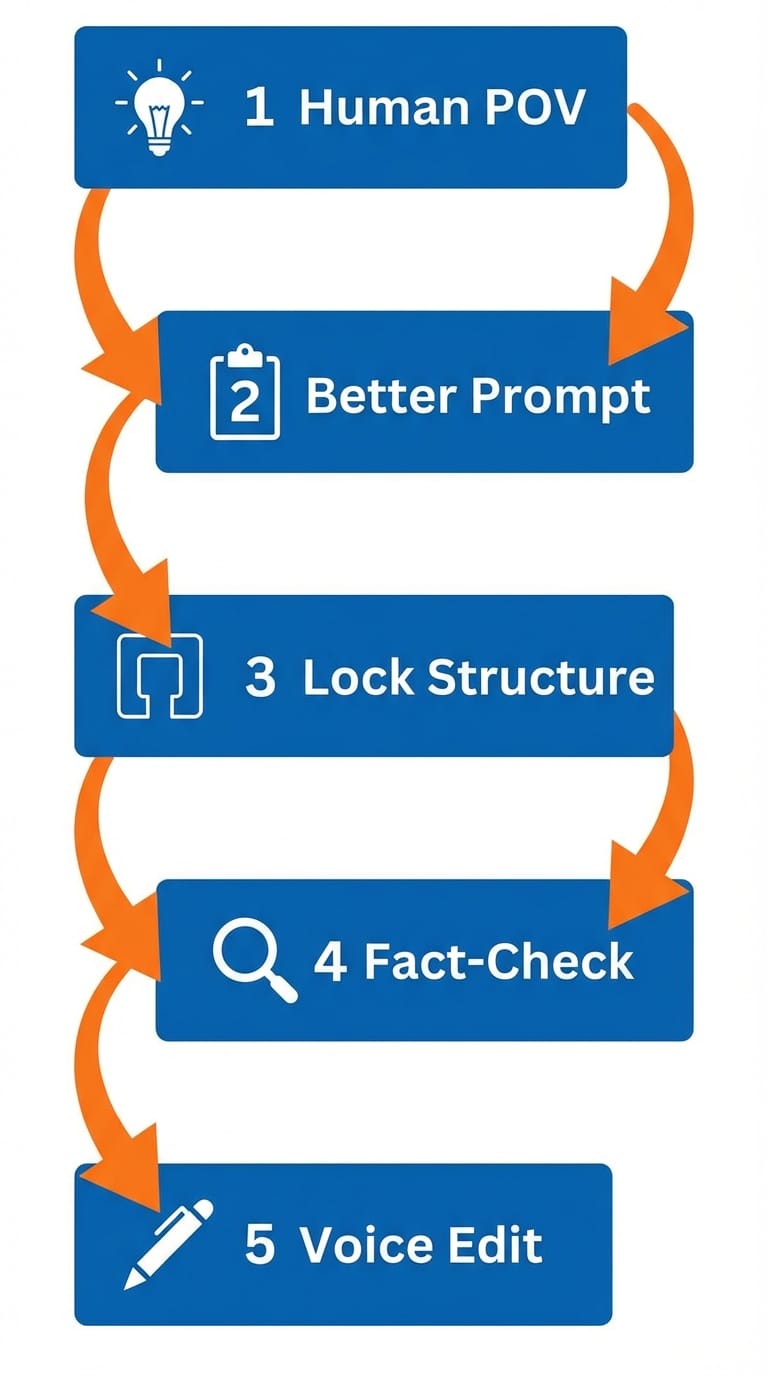
How-to: my 5-step workflow for AI-generated content that doesn’t stink
Here’s the process I recommend if you want the upside (speed) without the downside (publishing bland nonsense that sounds like it was written by a committee of microwaves).
- Start with a human POV.Before you prompt anything, write 3–5 bullet points with your real opinion. What do you actually believe? Where do you disagree with the crowd? This is the “soul” the model can’t invent.
- Prompt like you’re writing a creative brief.Bad prompt: “Write a blog post about AI content.”Good prompt: “Write for tech-savvy founders, casual tone, include contrarian viewpoint, give a 5-step workflow, add examples for marketing + docs, warn about hallucinations, end with a checklist.”If you wouldn’t hand vague instructions to a freelancer, don’t hand them to the model.
- Force structure before you generate paragraphs.Ask for an outline first. Then revise the outline. Then generate section-by-section. This keeps you from getting a 1,200-word blob that goes nowhere.
- Fact-check like you’re betting money.Anything that sounds like a statistic, a legal claim, a quote, or “Google says…” needs a source. If you can’t verify it quickly, delete it or rewrite it as opinion. Google’s guidelines emphasize fighting spam and deceptive practices—don’t hand them a reason to doubt you (source).
- Edit for voice, not grammar.AI grammar is usually fine. The real problem is personality. Add edge. Add specificity. Add real examples from your world. If your content could be published by any competitor with a logo swap, it’s not done.
The Bottom Line
AI-generated content wins when you use it to accelerate your thinking—not replace it. The best results come from human POV + tight prompts + real editing + ruthless verification.
Common mistakes (a.k.a. how people accidentally publish internet oatmeal)
- Publishing first drafts. AI is amazing at “first acceptable version.” That’s not the same as “worth reading.”
- Letting the model choose your positioning. If you don’t supply a point of view, it’ll default to safe, bland consensus.
- Using fake stats because they “sound right.” This is how brands lose credibility fast. If it matters, cite it. If you can’t cite it, don’t say it.
- Ignoring policy and disclosure realities. If you’re in regulated industries (health, finance, legal), you need a real review process. “But the AI wrote it” is not a defense.
FAQ (stuff people ask me all the time)
1) Will Google penalize AI-generated content?
Not automatically. Google targets low-quality and spammy content, regardless of whether a human or AI wrote it (Google Search Spam Policies). If you’re producing helpful, original, user-first content, you’re playing the right game.
2) Do I have to disclose I used AI?
Depends on context. For general marketing blogs, many brands don’t. For regulated topics, sensitive claims, or anything where trust is the product, I lean toward transparency. Also note: platforms have their own rules (for example, YouTube and others have disclosure policies for certain synthetic media). When in doubt, disclose.
3) What about copyright—can I own AI-generated text?
I’m not a lawyer, but the U.S. Copyright Office has said copyright protects human authorship, and purely AI-generated material may not qualify the same way (see the USCO guidance and updates: U.S. Copyright Office — AI). Practically: assume you need meaningful human contribution and editing if ownership matters.
4) What should I use AI content for first?
Start where speed matters and risk is low: internal docs, support macros, outlines, brainstorming, repurposing long-form into short-form. Then move outward to public content once your workflow is solid.
Action challenge (do this today, not “someday”)
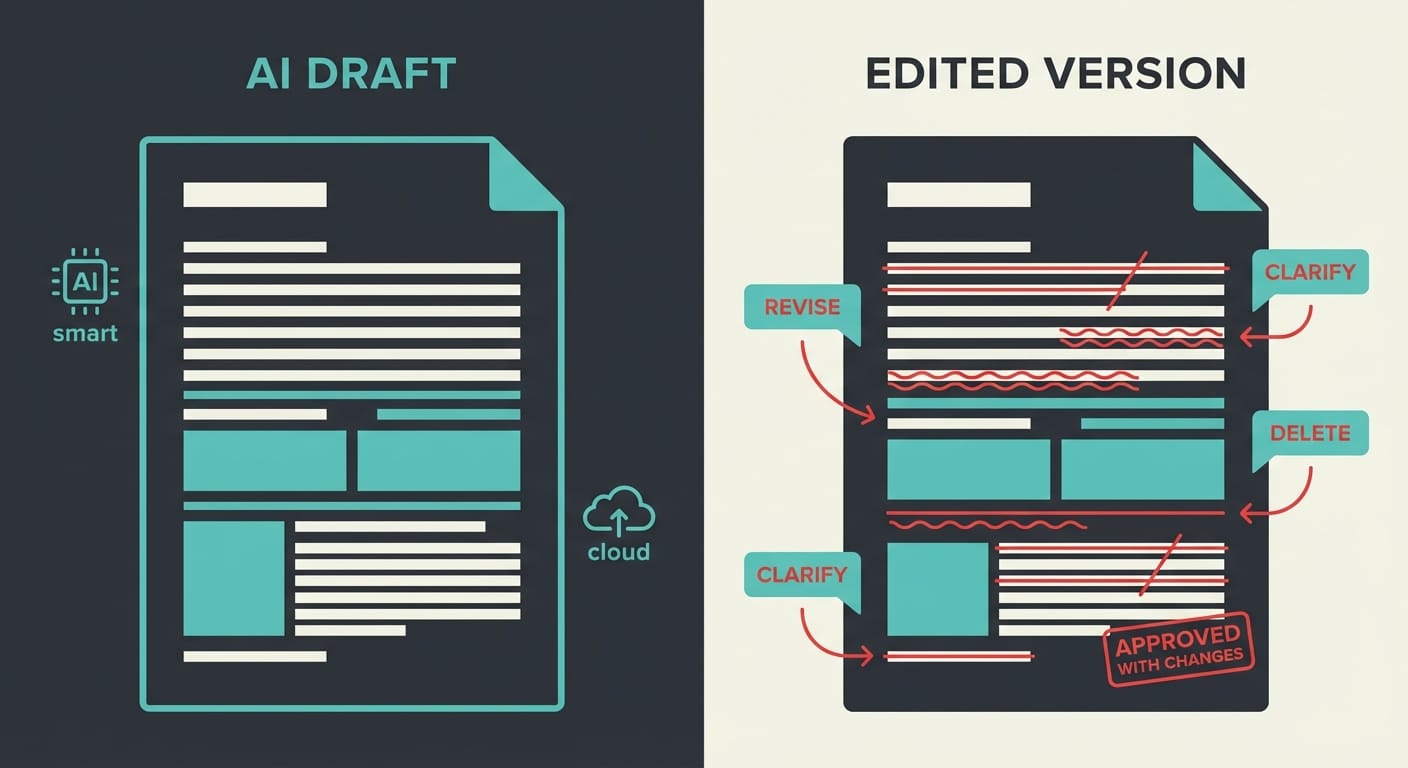
Pick one piece of content you’re working on this week and run it through the 5-step workflow above. But here’s the twist: before you prompt the model, write your own spicy POV in 3 bullets. If you can’t do that, no AI tool on earth can save the post.
Actionable takeaways:
- Write your POV first (AI can’t invent your conviction).
- Generate outlines before paragraphs.
- Verify anything factual with real sources.
- Edit for voice and specificity—make it impossible to “logo swap.”
- Use AI where it helps most: drafts, variations, repurposing, and structure.
That’s the game: AI makes content cheaper. Your job is to make it worth reading.
Sources
- Google Search Spam Policies
- OpenAI Terms of Use
- U.S. Copyright Office — AI