AI Blogs in 2026: Can You Still Make Money, or Is the Party Over?
In 2026, pure AI-written blogs struggle as search rewards real value and AI answer engines steal clicks. Hybrid human+AI blogs can still win—if you bring genuine expertise, unique assets, and diversified monetization.

Can you still build a monetized blog in 2026 if most of the content is AI-generated? Or are you basically trying to start a newspaper stand after everyone switched to smartphones?
Here’s the thing… the question isn’t “Does AI content work?” It’s “Does commoditized AI content still earn?” And in 2026, the internet is swimming in same-y posts that read like they were written by an enthusiastic intern who’s never used the product.
Look, I’ll be honest: a blog that relies solely on mass-produced AI articles as the product is generally not a solid long-term business model in 2026. Not because “Google hates AI,” but because Google (and readers) hate low-value content. And AI search tools are increasingly answering questions without sending traffic back to you, which is… not great for ad revenue.

The problem (and why pure AI blogs are getting squeezed)
In the old days, the game was simple: publish helpful posts, rank on Google, get traffic, earn money via ads and affiliates. That pipeline is now leaky in two places:
- Search engines are deprioritizing low-quality mass content. Google’s stance is basically: we don’t care how you made it, we care if it’s good. But most “pure AI” blogs publish at a volume and sameness that screams “made for search engines,” not humans. Google has been explicit that low-quality content—regardless of how it’s produced—won’t perform well. (Google: Helpful, people-first content)
- AI answer engines are taking the value without paying rent. Tools like ChatGPT, Perplexity, Gemini, and Copilot can summarize your post and satisfy the user without a click. Even if they cite you, the click-through rate is often tiny compared to classic search. That’s brutal if your whole monetization plan is “pageviews → ads.” (Wall Street Journal on AI disrupting publisher traffic)
Here’s what most people miss: AI didn’t just make content cheaper. It made “average content” basically worthless. If anyone can publish 10 posts a day, then the bar for what gets attention moves way up.
The solution: hybrid blogs (AI-assisted, human-owned) that act like businesses
If you want viability in 2026, you need to stop thinking like a blogger and start thinking like a business owner who happens to publish content.
The hybrid model is where things still work:
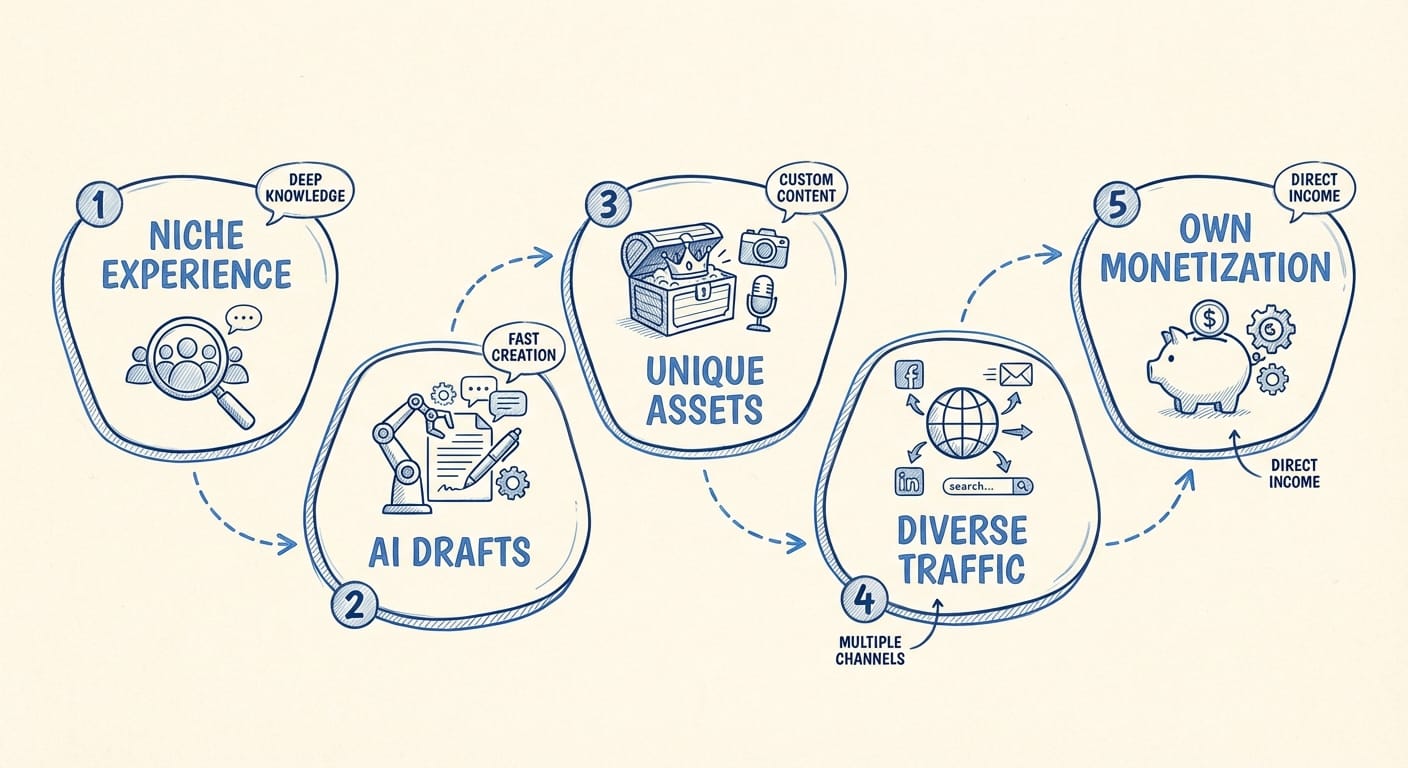
- AI helps you move faster (research, outlines, first drafts, SEO briefs).
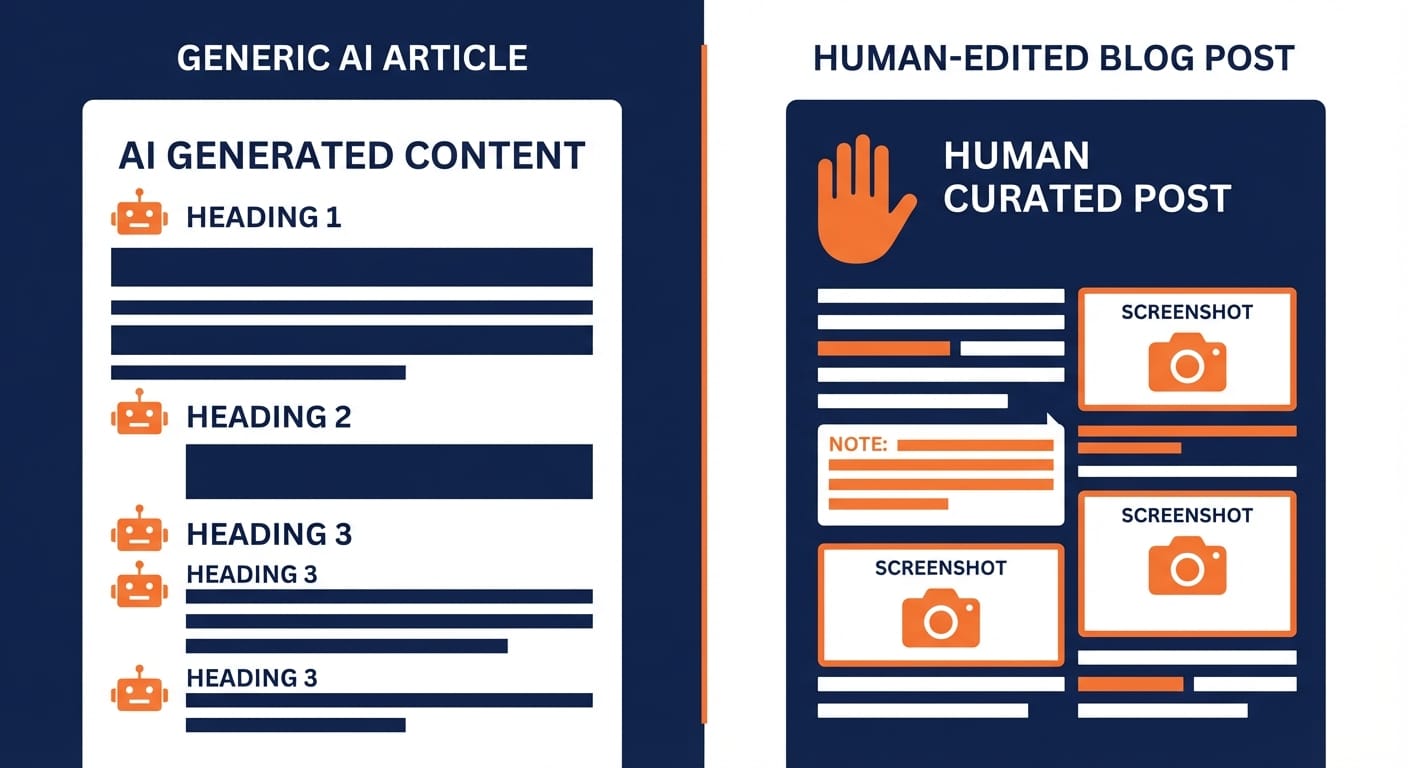
- A human adds the stuff that can’t be scraped from the internet: experience, testing, opinions, stories, niche expertise, product comparisons that aren’t generic, and an actual voice.
- Monetization doesn’t depend on one fragile traffic source.
Agencies are doing this at scale: using AI to boost output significantly (think 300–500% more production) while keeping humans in the loop for positioning, QA, and authority. The business model also shifts: instead of “pay per word,” agencies sell outcomes with retainers often in the $3,000–$12,000/month range for a defined content bundle. (Search Engine Journal on AI in content marketing)
Comparison: pure AI blog vs hybrid blog (2026 reality check)
5 practical moves to make an AI-assisted blog actually viable in 2026
If you want this to work, do these five things. Not two. Not “eventually.” All five.
- Pick a niche where lived experience matters.If your blog can be written from a Wikipedia summary, AI will eat your lunch. Write where you’ve done the thing: run the ads, built the workflow, fixed the bug, tested the gear.
- Use AI for drafts, not decisions.AI can outline and rewrite all day. But you decide the angle, the examples, the tools you’d actually bet your reputation on.
- Build something “non-scrapable” into every post.Original screenshots, your own mini case study, a template, a checklist, a benchmark you ran. Give readers a reason to save the page.
- Diversify traffic like you mean it.Relying on Google only is like building your house on a single stilts. Add YouTube (often ranks above blog posts), email, communities, partnerships, and direct referrals.
- Monetize beyond ads.Ads and affiliates can still be nice, but the winners use content to sell: consulting, productized services, digital products, courses, or even simple lead gen for higher-ticket offers.
The Bottom Line is…
Pure AI content blogs are mostly a dead-end in 2026 because search rewards value, and AI answer engines reduce clicks. Hybrid blogs can absolutely work—if you pair AI speed with human expertise and monetize like a business, not a pageview hobby.
Common mistakes I keep seeing (don’t do this)
- Publishing “10 posts a day” with no point of view. That’s not a strategy. That’s content confetti.
- Writing only for keywords. Keyword research still matters, but in 2026, “me too” SEO content is the fastest route to invisibility.
- Depending on affiliate programs you don’t control. Commissions change. Programs shut down. If that’s your only revenue, your blog is a house of cards.
FAQ
Does Google penalize AI-generated content in 2026?
Not automatically. Google’s guidance is that quality matters—not the method. Low-quality, unhelpful content tends to get ignored. (Google Search Central: AI-generated content)
Can I still make money with ads on an AI-assisted blog?
You can, but it’s harder if your traffic is unstable. Ads work best as a secondary stream, not the whole plan.
What’s the best monetization model for 2026?
In my opinion: something you control. Email list → product/service → repeatable offer. Affiliates and ads are “nice-to-haves.”
Will AI search tools kill blogging entirely?
No. But they will kill a lot of generic blogging. The blogs that survive feel more like brands, experts, and communities—not article factories.
Try this today (seriously)
Action challenge: pick one post on your site (or one you’re about to publish) and add one thing AI can’t fake—your screenshots, your numbers, your story, your template, your honest take. Then rewrite the intro in your own voice.
Because in 2026, the winners aren’t the people who publish the most. They’re the people who publish the most worth saving.
Sources: Google Search Central documentation on helpful content and AI content policies; reporting and analysis on AI answer engines and publisher traffic impacts (WSJ); Search Engine Journal coverage of AI’s role in content marketing and agency workflows.