AI Agents Are Taking Over Enterprise Software (And Honestly, It’s About Time)
Let’s talk about the thing everyone’s quietly building and loudly pretending is “just a pilot”: AI agents.
Not chatbots. Not “type a question, get a paragraph” tools. I mean autonomous agents that can watch a process, decide what to do next, take actions across systems, and keep going until the job’s done—without you babysitting every step.
In 2026, enterprise software is basically going through the same glow-up we saw when monolithic apps gave way to microservices. Only this time, it’s not just code that’s modular—it’s work.
From chatbots to agents: the difference is “answers” vs “outcomes”
Here’s the simplest way I can explain it:
- A chatbot is like asking a helpful intern, “What’s our refund policy?”
- An AI agent is like telling an ops manager, “Reduce refunds by 15% this quarter,” and they go pull reports, find patterns, update workflows, notify support, and track results.
Traditional enterprise chatbots mostly live in the “Q&A zone.” Agentic platforms are moving into the “do the thing” zone—monitoring systems, adjusting processes, and running end-to-end workflows, often through low-code/no-code setups that still respect compliance and governance. That’s a massive shift in what software is and what it’s for. [1]
And yes, it’s happening fast. Gartner is predicting that 40% of enterprise applications will embed AI agents by the end of 2026, up from less than 5% in 2025. [4] That’s not a gentle trend line. That’s a cliff.
Why this is exploding right now (hint: enterprises are tired)
Enterprises are drowning in tools. Every department has a SaaS stack that looks like a Jenga tower. And every “simple” workflow actually requires:
- three approvals,
- two data exports,
- a spreadsheet sacrifice,
- and one person named Chris who “knows how it works.”
AI agents are attractive because they promise something enterprises crave: less glue work. Less swivel-chair ops. Less “copy/paste between five systems.”
Also: money. The agentic AI market is projected to grow from about $7.8B to over $52B by 2030. [4] That kind of forecast doesn’t happen unless buyers are already pulling out credit cards.
Multi-agent orchestration: the “microservices moment” for work
One agent to rule them all sounds nice… until it’s a mess. Enterprises are learning (again) that specialization wins.
Instead of one mega-agent doing everything, companies are orchestrating teams of agents: one for IT ops, one for customer support triage, one for procurement, one for forecasting, and an orchestrator that coordinates the whole crew. Gartner even reported a 1,445% surge in multi-agent system inquiries from Q1 2024 to Q2 2025. [4]
If that number doesn’t make you raise an eyebrow, check your pulse.
Where agents are showing up first
Based on what’s getting funded and deployed, the early “serious” use cases are pretty consistent:
- IT operations: monitoring incidents, correlating logs, triggering remediations
- Customer service: resolving issues end-to-end, not just drafting replies
- Software engineering: planning tasks, generating code, running tests, opening PRs
- Supply chain: optimizing reorder points, detecting anomalies, coordinating vendors
These are high-volume, multi-step workflows with clear success metrics. Perfect agent territory. [4]
Copilots are becoming table stakes (and that’s not the same as agents)
I’m going to say something slightly spicy: copilots are the gateway drug.
They’re everywhere because they’re easy to adopt. They sit inside your existing tools and help you do what you already do—just faster. IDC predicts that in 2026, AI copilots will be embedded in 80% of enterprise workplace applications. [1]
But copilots still assume a human is driving. Agents assume the human is setting direction and constraints, then getting out of the way.
In practice, most enterprises will run a hybrid: copilots for knowledge work and drafting, agents for execution and automation. And honestly? That’s the right call. The goal isn’t replacing people—it’s replacing the soul-crushing parts of the job. [1]
Ambient intelligence: the “always on” layer nobody asked for (but everyone will use)
Here’s where it gets weird—in a good way.
Ambient intelligence is the idea that AI is just… there. Always watching signals, always ready to act, and smart enough to know when it should not act. [5]
Think of it like a great executive assistant. You don’t have to explicitly say, “Please notice I have back-to-back meetings and no time for prep.” They just know and adjust.
In enterprise terms, that looks like orchestrator agents coordinating specialized agents, aligned to business goals and preferences. [5] Done right, it’s magical. Done wrong, it’s a compliance officer’s nightmare. Which brings us to…
Governance is no longer optional (and vendors know it)
If you’re thinking, “Cool, but what about security, audit trails, and regulators?”—congrats, you’re qualified to run an enterprise AI program.
Governance is becoming a product category, not a checklist item. Research points to half of enterprise ERP vendors launching autonomous governance modules that combine explainable AI, automated audit trails, and real-time compliance monitoring. [3]
That’s not vendors being altruistic. That’s vendors reacting to high-profile failures and tightening regulation. (Also: they’d like to keep selling to banks.)
MCP and the fight against vendor lock-in
One of the most interesting moves: Model Context Protocol (MCP) servers. Around 30% of enterprise app vendors are expected to launch MCP servers, creating a more open standard for agents to collaborate securely across platforms. [3]
Translation: instead of being trapped in one vendor’s agent ecosystem, you can mix-and-match the best agents for the job—while still controlling data access and permissions.
I’m strongly pro this. Closed ecosystems are how you end up paying $2M/year for the privilege of exporting your own data.
The uncomfortable truth: agents might eat your SaaS licenses
Let’s address the elephant in the procurement room.
Agentic AI could reduce or eliminate expensive software licenses by letting organizations query underlying databases and execute processes directly through agents—potentially displacing big-ticket platforms like Salesforce, SAP, and Oracle in certain workflows. [2]
Now, will that happen overnight? No. Enterprises don’t rip out core systems like they’re swapping a Spotify playlist.
But will agents route around some of those systems? Absolutely. And that’s the part incumbents should be losing sleep over: not “AI inside our product,” but “AI making our product less necessary.”
What the 2026 enterprise stack is starting to look like
We’re seeing a three-tier ecosystem form:
- Tier 1: hyperscalers providing infrastructure and foundation models
- Tier 2: big enterprise vendors embedding agents into existing platforms
- Tier 3: agent-native startups building from scratch with agent-first architecture
The agent-native startups are the fun ones to watch. They’re not trying to “add AI” to old workflows. They’re asking, “What if the workflow is the agent?” [4]
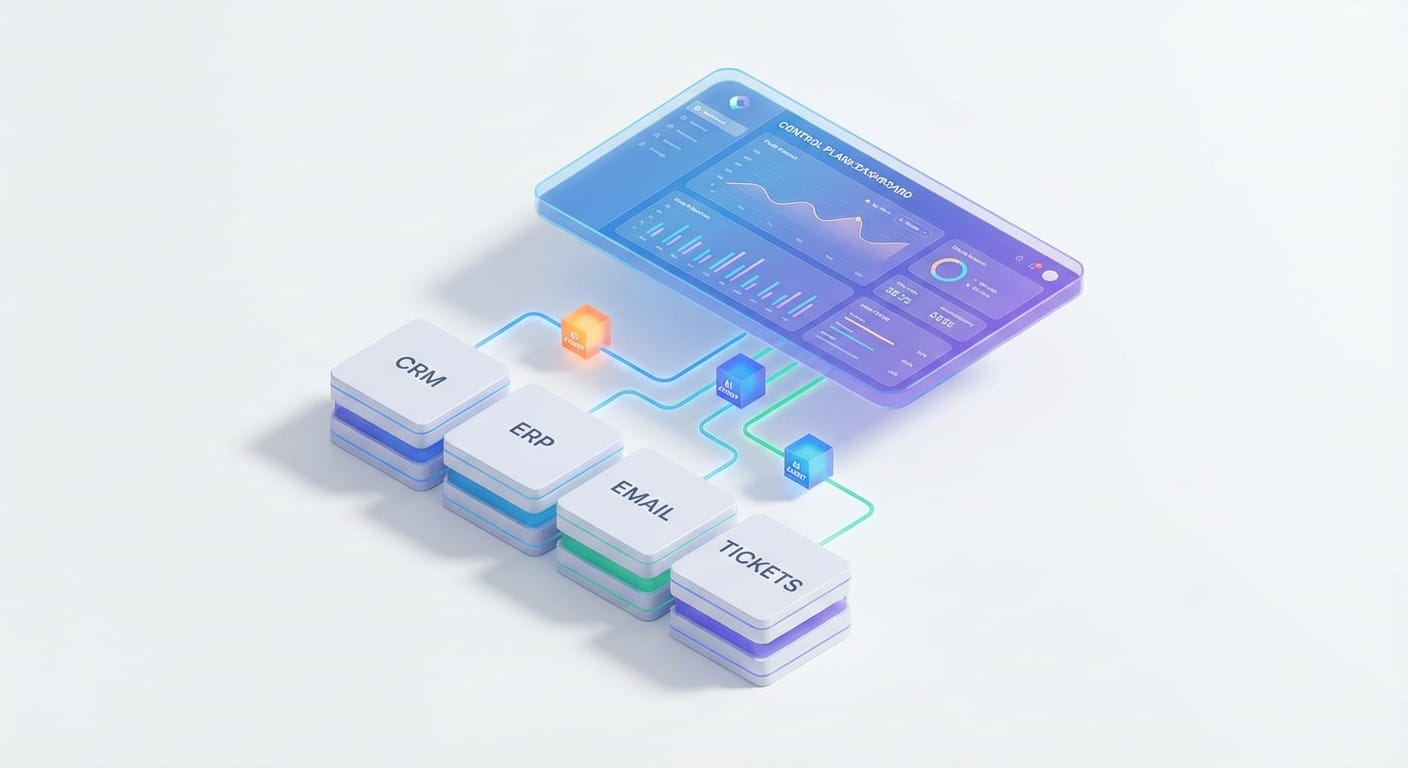
Also, we’re getting real infrastructure around this: agent control planes and multi-agent dashboards that let you kick off tasks from one place while agents operate across browsers, inboxes, editors, and internal tools. [6] That’s when it stops feeling like a demo and starts feeling like a new operating model.
My practical take: how to adopt agents without lighting your hair on fire
If you’re leading this inside a company (or selling into one), here’s what I’d do—and what I’d avoid.
1) Start with one workflow that has a scoreboard
Pick something with clear inputs/outputs and a measurable win: time-to-resolution, cost per ticket, days-to-close, on-time delivery. If you can’t measure it, you’ll argue about vibes forever.
2) Treat agents like production software, not a science fair
That means: permissions, logging, audit trails, rollback plans, and human-in-the-loop controls where it matters. The “move fast” part is fine. The “break compliance” part is not.
3) Prefer multi-agent teams over one mega-agent
Specialized agents are easier to test, easier to secure, and easier to replace. Same lesson we learned with microservices—just applied to work.
4) Demand proof of training and edge-case handling
Buyers are increasingly expecting transparency around simulation-based training—how many simulated hours, what edge cases were tested, what failure modes exist. [5] Ask vendors for that. If they hand-wave, that’s your cue to walk.
5) Don’t forget the humans
The best deployments I’ve seen don’t “replace” teams. They raise the floor: fewer repetitive tasks, faster decisions, better handoffs. Put time back into the parts of the job that require judgment and context.
So yeah—AI agents are the new enterprise UI
For 20 years, enterprise software has been “click here, fill this form, route to that queue.” Agents flip it into: “state the goal, set the rules, approve exceptions.”
And once companies get a taste of that… they won’t want to go back.
Actionable takeaways
- Pick one workflow with measurable impact and agent-ify it end-to-end (not just “draft an email”).
- Design for multi-agent orchestration early—specialization beats a giant do-everything bot. [4]
- Invest in governance like it’s core infrastructure, because it is. [3]
- Push for openness (MCP-style interoperability) to avoid getting locked into one vendor’s agent universe. [3]
- Track ROI in weeks, not years—the 2026 winners are prioritizing near-term, provable value. [2]
Sources
- [1] IDC – Enterprise adoption of GenAI copilots and agentic platforms (2026 predictions)
- [2] Analysis on convergence of AI + agentic platforms and cost/license disruption in enterprise software
- [3] Enterprise vendor predictions: autonomous governance modules and MCP server adoption
- [4] Gartner – Agentic AI market growth, enterprise app embedding forecasts, and multi-agent inquiry surge
- [5] Research on ambient intelligence and simulation-based training requirements
- [6] Research on agent control planes and multi-agent dashboards as enterprise infrastructure