AI Can Make Your Affiliate Launch Reviews Hit Harder (Without Being Spammy)
AI won’t make your affiliate reviews trustworthy—but it will help you promote them faster, smarter, and across more channels without sounding spammy. Here’s a practical 5-step playbook to repurpose, personalize, and optimize your launch promotion using AI.

Here’s my hot take: most affiliate launch reviews don’t fail because the product is bad—they fail because the promotion is lazy.
You’ve seen it, right? The same “Here are the features… here’s my link… please buy” template copy-pasted across the internet like a bad chain email from 2006. That’s not marketing. That’s wishful thinking.
AI won’t magically make people trust you. But it will help you ship faster, personalize smarter, and show up in more places—without losing your voice or your ethics. Let’s talk about how to use it to promote affiliate launch reviews the right way.
The real problem: launch windows are short and attention is expensive
Affiliate launches are basically pop-up shops. You’ve got a small window (sometimes a week, sometimes hours) where the market is paying attention. After that? It’s on to the next shiny thing.

And right now, attention is even more fragile. When 180+ million people are dealing with a massive winter storm, travel chaos, and power outage prep, you can’t assume your audience has the bandwidth for a 3,000-word essay today. Flight cancellations are in the thousands and millions are preparing for ice-related outages—people are distracted, stressed, and scanning on mobile when they can. That’s not political. That’s reality. [1][7][8]
So what wins? Clear messaging, the right format for the right channel, and distribution that doesn’t depend on “hopefully Twitter likes me today.”
That’s where AI is legitimately useful.
My 5-step AI playbook for promoting affiliate launch reviews
I’m going to keep this practical. If you do nothing else, do these five steps every time you publish a launch review.
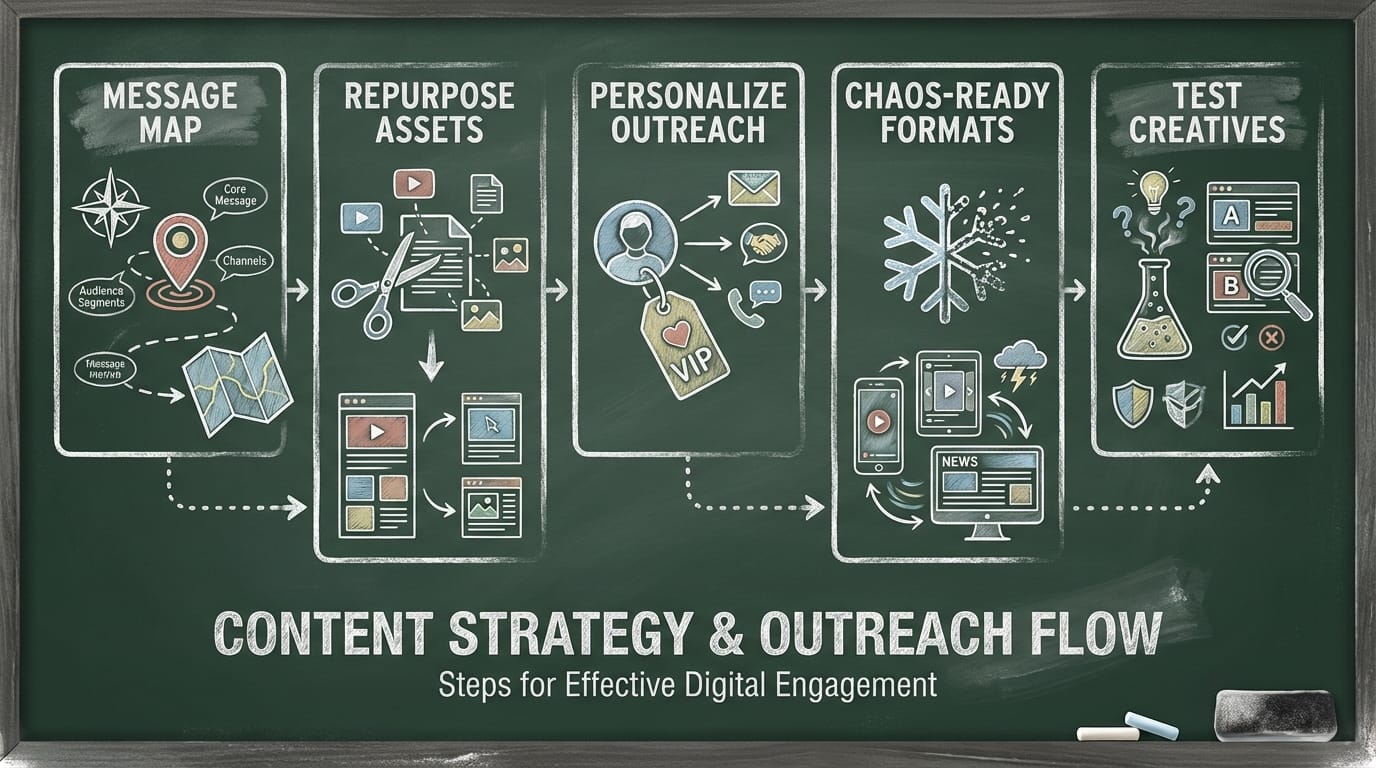
1) Build a “message map” (so you’re not reinventing the wheel)
Before you generate anything, define the core of your review:
- Who it’s for (and who it’s not for)
- The one big outcome it helps achieve
- Your proof (demo, screenshots, experience, results, or comparisons)
- Your stance (what you like, what you don’t, what you’d change)
- Your CTA (bonus, deadline, guarantee notes)
Then ask AI to turn that into channel-ready angles: “Write 10 hooks for busy people,” “Give me 5 contrarian takes,” “Summarize in 3 bullets for email.”
Analogy time: your message map is like a master recipe. AI helps you plate it for different restaurants.
2) Repurpose into channel-native assets (without sounding like a robot)
This is the biggest win: AI can take one review and generate versions that actually fit where you’re posting.
- Email: 2 subject lines + a short “storm-mode” version for distracted readers + a longer story version for warm leads
- YouTube/TikTok/Reels: a 45-second script + 3 punchy talking points
- X/Threads/LinkedIn: 5 post variations (question, mini-case study, myth-busting, “who it’s for,” and “who should skip it”)
- Reddit/communities: a value-first post that links only after it’s helpful (and follows the rules… please)
The key is prompting AI with your voice. I literally paste a paragraph I wrote and say: “Match this tone. Keep contractions. No hype. One mild joke max.” Works great.
3) Personalize your outreach at scale (without being creepy)
If you’ve got a list, a community, or even a spreadsheet of contacts, AI can help you personalize intros and angles.
Example: you’re promoting a productivity tool. Your audience splits into founders, marketers, and freelancers. Same product. Different pain.
- Founders: “This helps you stop being the human API for your team.”
- Marketers: “This turns campaigns into reusable systems.”
- Freelancers: “This saves you from unpaid admin work.”
AI can generate those segments and draft tailored emails/posts. But don’t fake intimacy. No “Loved your post about your dog’s birthday” unless you actually read it. People can smell that a mile away.
4) Prepare for real-world chaos (yes, weather counts)
Promotion is a logistics problem. And logistics breaks when the world gets weird—like widespread winter storms causing power outages and massive flight disruptions. [1][7][8]
AI helps you build a resilience plan:
- Create short-form backup promos for days when people are distracted
- Generate SMS-friendly copy (if you use SMS) when inboxes are ignored
- Draft a “power outage” email: plain text, fast-loading, straight to the point
I’m not saying “newsjack” a storm. I’m saying: adapt your format to the moment. When attention is fragmented, clarity wins.
5) Optimize the funnel: test creatives, not your integrity
AI is awesome for rapid testing:
- Generate 5 headline variants for your review page
- Create 3 different bonus descriptions
- Rewrite your intro for three reader types: skeptical, curious, ready-to-buy
But here’s my line in the sand: don’t use AI to manufacture fake testimonials, fake scarcity, or fake “I used this for months” stories. That stuff converts… until it destroys your reputation. And affiliate marketing is basically a long game of trust.
Common mistakes (a.k.a. how people make AI look bad)
- They publish AI text with zero opinion. A review without a stance is a brochure.
- They skip disclosure. Disclose affiliate relationships clearly. It’s not optional morally, and often not legally either.
- They spray-and-pray distribution. Post fewer things in more relevant places. AI makes volume easy; don’t confuse easy with effective.
- They don’t fact-check. AI will confidently hallucinate features. Your audience will confidently never click your link again.
Quick wins you can do in 30 minutes
- Ask AI to write 10 hooks for your review based on your actual stance.
- Generate a plain-text email version of your review (great for “busy week” moments).
- Create a comparison snippet: “If you’re considering X vs Y, here’s the difference.”
- Draft a 2-minute video script that covers: problem → demo → who it’s for → CTA.
FAQ
Does Google punish AI-written affiliate content?
Google’s stance is about quality, not whether a robot touched the keyboard. Thin, unhelpful content gets hit—AI or not. Focus on originality, proof, and usefulness. (And yes, add real screenshots/demos.) [10]
What’s the best place to use AI: writing or distribution?
Distribution, 100%. Your opinion should be human. AI should help you reformat it into emails, scripts, posts, and follow-ups so you actually ship.
How do I keep my voice?
Feed AI a “voice sample” paragraph you wrote, plus a short style checklist (like “casual, skeptical, no hype, short sentences”). Then edit the first 10% and the CTA manually—those are the trust zones.
Can AI help with compliance and disclosures?
It can draft disclosure language and remind you where to place it, but you’re still responsible for doing it correctly. The FTC’s endorsement guidance is worth reading once and bookmarking forever. [11]
Sources
- [1] Storm impact and emergency declarations summary (research provided, Jan 2026).
- [7] Travel disruptions, flight cancellations, ice/snow threats (research provided, Jan 2026).
- [8] Brutal cold and wind chills; federal office closures; grid readiness concerns (research provided, Jan 2026).
- [10] Google Search Central: guidance on AI-generated content and helpful content principles: https://developers.google.com/search/blog
- [11] U.S. FTC Endorsement Guides (affiliate disclosure basics): https://www.ftc.gov/business-guidance/advertising-marketing/endorsements-influencers-reviews
Action challenge
Pick one launch review you’ve already written. Today, use AI to create (1) a plain-text email, (2) a 60-second video script, and (3) five social hooks—all based on your real stance. Post the email and one hook, then come back tomorrow and ship the video. Momentum beats perfection every time.